

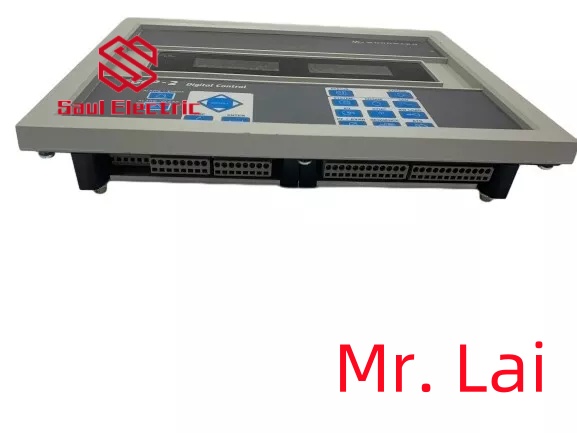
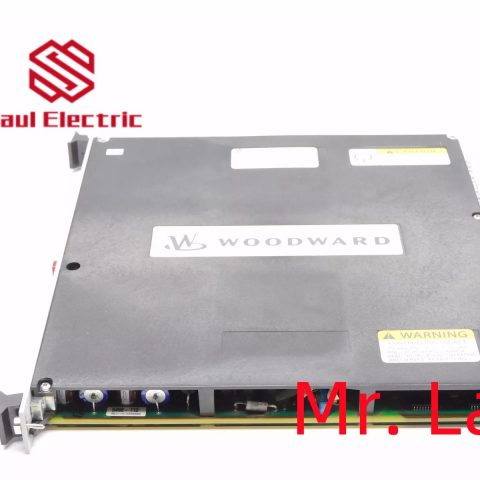
Woodward 1691-143 505 Turbine Control | 100% Original
1.1691-143 Product Overview

The Woodward 1691-143 belongs to the 505/505E series digital turbine controllers. It is a microprocessor-based control module designed for single-valve steam turbines,
including single extraction/admission systems or split-range actuator configurations.
The controller features a front panel Operator Control Panel (OCP) with a two-line, 24-character display and multi-function keypad, allowing easy on-site configuration and monitoring.
2. 1691-143 Technical Specifications and Parameters
| Parameter | Details |
|---|---|
| Power Supply | +24 VDC, approx. 1 A |
| I/O Outputs | Discrete Outputs: 8 Analog Outputs: 6 Actuator Outputs: 2 |
| Display / HMI | Two-line, 24-character LCD, with multi-function keypad |
| Dimensions | Approx. 14 × 11 × 4 in (35.6 × 27.9 × 10.2 cm) |
| Weight | Approx. 9.11 lbs (4.13 kg) |
| Operating Temperature | –4 to +140 °F (–20 to +60 °C) |
| Storage Temperature | –40 to +185 °F (–40 to +85 °C) |
| Humidity Standard | 95% RH at 20-55 °C for 48 hours without damage |
| Protection Class | Typically meets industrial dust and water protection standards |
| Communication Protocol | Supports Modbus, RS-232 / RS-422 serial interfaces |

3. Brand History
Woodward, Inc., founded in 1870 and headquartered in Fort Collins, Colorado, USA, is a global leader in energy control systems. The company has a long history of innovation in turbine control, engine management,
and power generation systems.
Woodward products are widely recognized for their reliability and precision in demanding industrial and power generation applications.
4. Applications in Industrial Automation
The 1691-143 plays a critical role in industrial automation and power generation environments:
- Steam Turbine Control: Manages startup, speed regulation, and extraction/admission control of steam turbines.
- Power Generation Systems: Used in power plants to regulate turbine-driven generators for stable frequency and load management.
- Compressor and Pump Drive Control: Ensures precise speed control for turbine-driven compressors and pumps.
- Process Industry Applications: Applied in chemical plants, refineries, and other industries requiring precise turbine operation.
- Safety and Protection Functions: Includes overspeed protection, critical speed avoidance, actuator travel limits, and event logging for operational safety.

2) DLT/SDLT tape drive
DLT (digital linear tape) technology, also known as digital linear tape technology, was first developed by DEC in 1985 and is
mainly used in VAX systems. Later, it was purchased by Kunteng Company and its technology was improved. DLT adopts linear
recording technology, which is characterized by large capacity and high speed, but at a higher price. DLT products are mainly used in
the mid to high end server market and tape library application systems, with a rapidly growing market share. At present, the capacity of
DLT drives varies from 10GB to 40GB, with data transfer speeds ranging from 1.25MB/s to 5MB/s. Super DLT (SDLT) technology was
launched by Quantum Corporation in 2001. The capacity of SDLT is 110GB, nearly three times that of DLT tape series products, and the
transfer rate is 11MB/s, twice that of DLT. Although SDLT has made many improvements to DLT tapes, it is still compatible with the earliest
DLT tapes and has good read back compatibility with DLT 4000, 7000, and 8000 drives.
(3) VXA tape drive
VXA is Exabyte”s latest tape drive technology positioned in the low-end market. The first generation product of VXA technology, VXA-1 tape
equipment, has a single machine capacity of 66GB and a data transfer rate of 6MB/s (compressed). Its capacity and performance are three
times that of DDS-3, and its speed is the same as DDS-4, but its capacity exceeds DDS-4.
(4) AIT Tape Drive
AIT (Advanced Intelligent Tape) was developed by Sony and launched on the market in 1996. AIT-3 can write 100GB (260GB, compressed)
of data to a 230m long 8mm magnetic tape at a sustained data transfer rate of 12MB/s (31MB/s, compressed), which is as high as the storage
capacity provided by LTO media, but occupies only one-third of the space of LTO.


There are no reviews yet.