

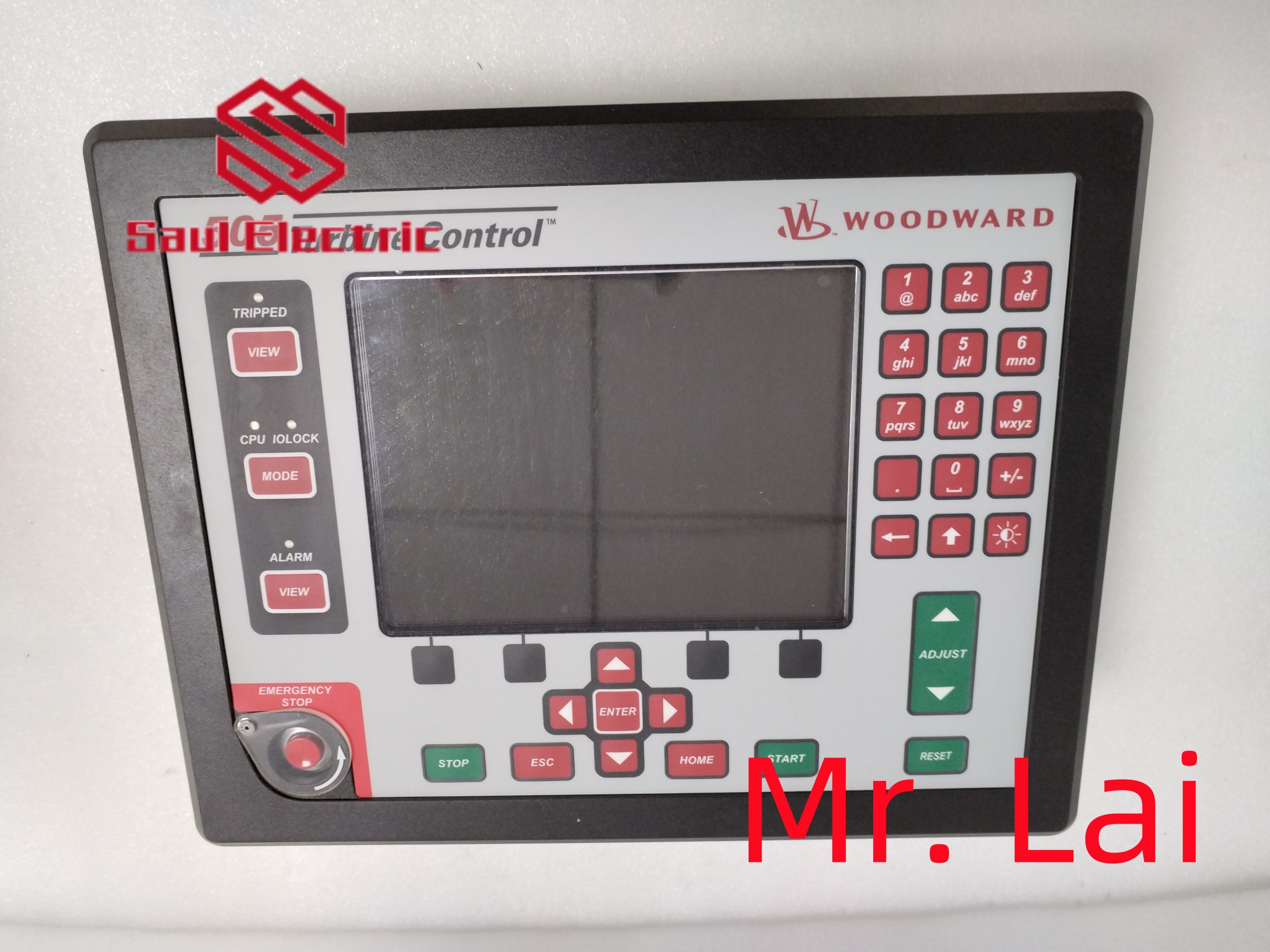
Woodward 3313-055 | Governor | Controller | Potential Converter
1.3313-055 Product Overview

The Woodward 3313-055 belongs to the 505/505E series digital turbine controllers. It is a microprocessor-based control module designed for single-valve steam turbines,
including single extraction/admission systems or split-range actuator configurations.
The controller features a front panel Operator Control Panel (OCP) with a two-line, 24-character display and multi-function keypad, allowing easy on-site configuration and monitoring.
2. 3313-055 Technical Specifications and Parameters
| Parameter | Details |
|---|---|
| Power Supply | +24 VDC, approx. 1 A |
| I/O Outputs | Discrete Outputs: 8 Analog Outputs: 6 Actuator Outputs: 2 |
| Display / HMI | Two-line, 24-character LCD, with multi-function keypad |
| Dimensions | Approx. 14 × 11 × 4 in (35.6 × 27.9 × 10.2 cm) |
| Weight | Approx. 9.11 lbs (4.13 kg) |
| Operating Temperature | –4 to +140 °F (–20 to +60 °C) |
| Storage Temperature | –40 to +185 °F (–40 to +85 °C) |
| Humidity Standard | 95% RH at 20-55 °C for 48 hours without damage |
| Protection Class | Typically meets industrial dust and water protection standards |
| Communication Protocol | Supports Modbus, RS-232 / RS-422 serial interfaces |

3. Brand History
Woodward, Inc., founded in 1870 and headquartered in Fort Collins, Colorado, USA, is a global leader in energy control systems. The company has a long history of innovation in turbine control, engine management,
and power generation systems.
Woodward products are widely recognized for their reliability and precision in demanding industrial and power generation applications.
4. Applications in Industrial Automation
The 3313-055 plays a critical role in industrial automation and power generation environments:
- Steam Turbine Control: Manages startup, speed regulation, and extraction/admission control of steam turbines.
- Power Generation Systems: Used in power plants to regulate turbine-driven generators for stable frequency and load management.
- Compressor and Pump Drive Control: Ensures precise speed control for turbine-driven compressors and pumps.
- Process Industry Applications: Applied in chemical plants, refineries, and other industries requiring precise turbine operation.
- Safety and Protection Functions: Includes overspeed protection, critical speed avoidance, actuator travel limits, and event logging for operational safety.

What is Arduino?
Arduino is an open-source hardware/software programming platform based on Atmel microcontrollers. Open source means that circuit schematics
and software source code used in design can be obtained for free, and enthusiasts can modify them. The Arduino development board,
along with its analog and digital inputs and outputs, is an ideal choice for artists, designers, and electronics enthusiasts who wish to
assemble systems together without requiring extensive knowledge of digital design. The concave connectors arranged in a row can
provide input and output signals on the Arduino board, and a single lead or single column (SIL) connector can be inserted into it.
The Arduino development board will have at least:
9 digital pins that can be used as input/output channels. Some of them can be set as PWM (Pulse Width Modulation) outputs.
The PWM signal is a square wave, and its pulse width can be changed. PWM is used for speed and position control of motors
and servers in robotics and remote control applications
4 analog input channels.
At least one serial port, which can also be used to download code to Arduino
Some boards also have a series of analog output channels.
The functionality of pins is highly flexible, with some pins being configurable as analog or digital. Digital pins can be configured as inputs or outputs.
When Arduino boards receive input from sensors connected to these analog and digital inputs, they sense the surrounding environment.
They can also control actuators such as motors, alarms, and electric valves, or turn on LEDs, lights, or other visual indicators. The output
driving capability is limited, so transistors, FETS, or relays must usually be used between the Arduino output pin and the driven device.
However, there is an output that can directly drive the LED.



There are no reviews yet.