

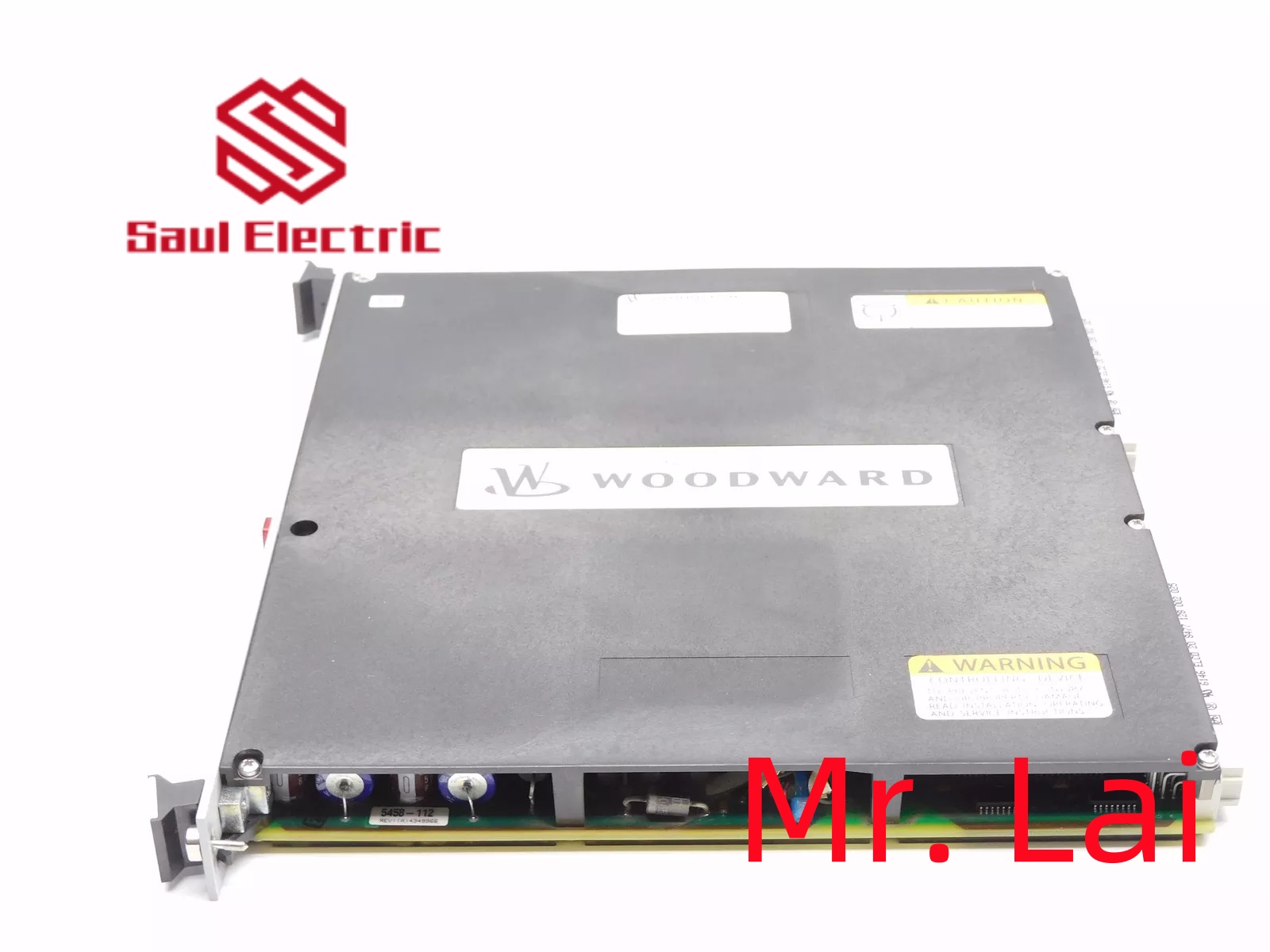
Woodward 5437-524 from SAUL ELECTRIC | In Stock
1.5437-524 Product Overview

The Woodward 5437-524 belongs to the 505/505E series digital turbine controllers. It is a microprocessor-based control module designed for single-valve steam turbines,
including single extraction/admission systems or split-range actuator configurations.
The controller features a front panel Operator Control Panel (OCP) with a two-line, 24-character display and multi-function keypad, allowing easy on-site configuration and monitoring.
2. 5437-524 Technical Specifications and Parameters
| Parameter | Details |
|---|---|
| Power Supply | +24 VDC, approx. 1 A |
| I/O Outputs | Discrete Outputs: 8 Analog Outputs: 6 Actuator Outputs: 2 |
| Display / HMI | Two-line, 24-character LCD, with multi-function keypad |
| Dimensions | Approx. 14 × 11 × 4 in (35.6 × 27.9 × 10.2 cm) |
| Weight | Approx. 9.11 lbs (4.13 kg) |
| Operating Temperature | –4 to +140 °F (–20 to +60 °C) |
| Storage Temperature | –40 to +185 °F (–40 to +85 °C) |
| Humidity Standard | 95% RH at 20-55 °C for 48 hours without damage |
| Protection Class | Typically meets industrial dust and water protection standards |
| Communication Protocol | Supports Modbus, RS-232 / RS-422 serial interfaces |

3. Brand History
Woodward, Inc., founded in 1870 and headquartered in Fort Collins, Colorado, USA, is a global leader in energy control systems. The company has a long history of innovation in turbine control, engine management,
and power generation systems.
Woodward products are widely recognized for their reliability and precision in demanding industrial and power generation applications.
4. Applications in Industrial Automation
The 5437-524 plays a critical role in industrial automation and power generation environments:
- Steam Turbine Control: Manages startup, speed regulation, and extraction/admission control of steam turbines.
- Power Generation Systems: Used in power plants to regulate turbine-driven generators for stable frequency and load management.
- Compressor and Pump Drive Control: Ensures precise speed control for turbine-driven compressors and pumps.
- Process Industry Applications: Applied in chemical plants, refineries, and other industries requiring precise turbine operation.
- Safety and Protection Functions: Includes overspeed protection, critical speed avoidance, actuator travel limits, and event logging for operational safety.

Although analog control may seem intuitive and simple, it is not always very economical or feasible. One of the points is that analog
circuits are prone to drift over time, making it difficult to adjust. The precise analog circuit that can solve this problem may be very large,
bulky (such as old-fashioned home stereo equipment), and expensive. Analog circuits may also generate severe heat, and their power consumption is
proportional to the product of the voltage and current at both ends of the working component. Analog circuits may also be sensitive to noise
, and any disturbance or noise will definitely change the magnitude of the current value.
digital control
By digitally controlling analog circuits, the cost and power consumption of the system can be significantly reduced. In addition, many microcontrollers
and DSPs already include PWM controllers on the chip, making the implementation of digital control easier.
In short, PWM is a method of digitally encoding the level of an analog signal. By using a high-resolution counter, the duty cycle of the
square wave is modulated to encode the level of a specific analog signal. The PWM
signal is still digital because at any given moment, the full amplitude DC power supply is either completely ON or completely OFF.
A voltage or current source is applied to an analog load in a repetitive pulse sequence of ON or OFF. When it is turned on, the DC power supply
is applied to the load, and when it is turned off, the power supply is disconnected. As long as the bandwidth is sufficient, any analog value can be encoded using PWM.



There are no reviews yet.