

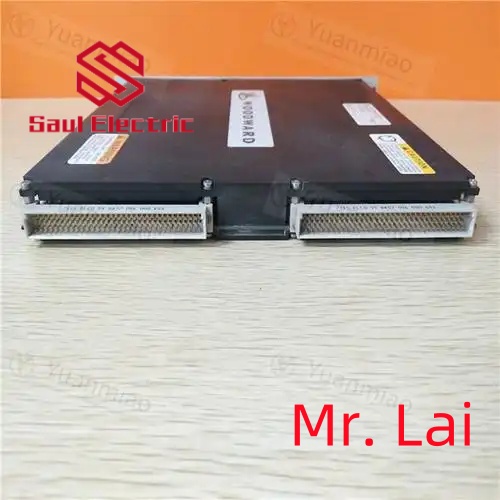
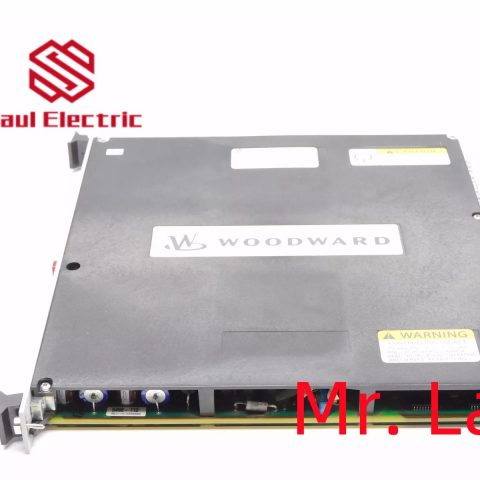
Woodward 5439-929 | Governor | Controller | Potential Converter
1.5439-929 Product Overview

The Woodward 5439-929 belongs to the 505/505E series digital turbine controllers. It is a microprocessor-based control module designed for single-valve steam turbines,
including single extraction/admission systems or split-range actuator configurations.
The controller features a front panel Operator Control Panel (OCP) with a two-line, 24-character display and multi-function keypad, allowing easy on-site configuration and monitoring.
2. 5439-929 Technical Specifications and Parameters
| Parameter | Details |
|---|---|
| Power Supply | +24 VDC, approx. 1 A |
| I/O Outputs | Discrete Outputs: 8 Analog Outputs: 6 Actuator Outputs: 2 |
| Display / HMI | Two-line, 24-character LCD, with multi-function keypad |
| Dimensions | Approx. 14 × 11 × 4 in (35.6 × 27.9 × 10.2 cm) |
| Weight | Approx. 9.11 lbs (4.13 kg) |
| Operating Temperature | –4 to +140 °F (–20 to +60 °C) |
| Storage Temperature | –40 to +185 °F (–40 to +85 °C) |
| Humidity Standard | 95% RH at 20-55 °C for 48 hours without damage |
| Protection Class | Typically meets industrial dust and water protection standards |
| Communication Protocol | Supports Modbus, RS-232 / RS-422 serial interfaces |

3. Brand History
Woodward, Inc., founded in 1870 and headquartered in Fort Collins, Colorado, USA, is a global leader in energy control systems. The company has a long history of innovation in turbine control, engine management,
and power generation systems.
Woodward products are widely recognized for their reliability and precision in demanding industrial and power generation applications.
4. Applications in Industrial Automation
The 5439-929 plays a critical role in industrial automation and power generation environments:
- Steam Turbine Control: Manages startup, speed regulation, and extraction/admission control of steam turbines.
- Power Generation Systems: Used in power plants to regulate turbine-driven generators for stable frequency and load management.
- Compressor and Pump Drive Control: Ensures precise speed control for turbine-driven compressors and pumps.
- Process Industry Applications: Applied in chemical plants, refineries, and other industries requiring precise turbine operation.
- Safety and Protection Functions: Includes overspeed protection, critical speed avoidance, actuator travel limits, and event logging for operational safety.

Still based on our previous motor example, the expectation here is our expected motor speed of 100 revolutions per minute,
and the feedback is the actual motor speed of 80 revolutions per minute obtained through a Hall sensor. We subtract them to
obtain an error, and then send it to the controller. The controller calculates the expected speed of 120 revolutions per minute
based on the internal algorithm, which can make the actual motor speed exactly equal to the expectation.
Since the error and controller output are both time-varying, we assume them to be err (t) and U (t), respectively, so that we can
derive the formula for continuous PID
U(t)=Kp∗err(t)+Ki∗∫err(t)dt+Kd∗derr(t)dtU(t)=Kp∗err(t)+Ki∗∫err(t)dt+Kd∗derr(t)dt
After performing proportional, integral, and differential operations on err (t), weighted summation is performed to obtain the output
U (t). Why do we need all three at the same time? Let”s qualitatively analyze the meaning of each item——
Firstly, assuming that both Ki and Kd coefficients are 0, the formula changes to
U(t)=Kp∗err(t)U(t)=Kp∗err(t)
What would the output result be if the output quantity varied proportionally with the size of the error? (Blue line represents output,
yellow line represents expectation, purple line represents error)


There are no reviews yet.