

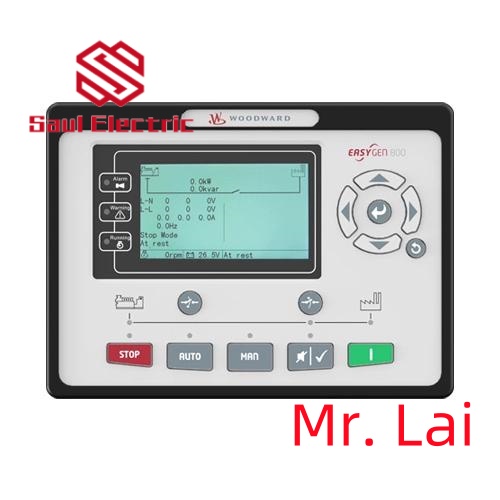
Woodward 5461-117 505 Turbine Control | 100% Original
1.5461-117 Product Overview

The Woodward 5461-117 belongs to the 505/505E series digital turbine controllers. It is a microprocessor-based control module designed for single-valve steam turbines,
including single extraction/admission systems or split-range actuator configurations.
The controller features a front panel Operator Control Panel (OCP) with a two-line, 24-character display and multi-function keypad, allowing easy on-site configuration and monitoring.
2. 5461-117 Technical Specifications and Parameters
| Parameter | Details |
|---|---|
| Power Supply | +24 VDC, approx. 1 A |
| I/O Outputs | Discrete Outputs: 8 Analog Outputs: 6 Actuator Outputs: 2 |
| Display / HMI | Two-line, 24-character LCD, with multi-function keypad |
| Dimensions | Approx. 14 × 11 × 4 in (35.6 × 27.9 × 10.2 cm) |
| Weight | Approx. 9.11 lbs (4.13 kg) |
| Operating Temperature | –4 to +140 °F (–20 to +60 °C) |
| Storage Temperature | –40 to +185 °F (–40 to +85 °C) |
| Humidity Standard | 95% RH at 20-55 °C for 48 hours without damage |
| Protection Class | Typically meets industrial dust and water protection standards |
| Communication Protocol | Supports Modbus, RS-232 / RS-422 serial interfaces |

3. Brand History
Woodward, Inc., founded in 1870 and headquartered in Fort Collins, Colorado, USA, is a global leader in energy control systems. The company has a long history of innovation in turbine control, engine management,
and power generation systems.
Woodward products are widely recognized for their reliability and precision in demanding industrial and power generation applications.
4. Applications in Industrial Automation
The 5461-117 plays a critical role in industrial automation and power generation environments:
- Steam Turbine Control: Manages startup, speed regulation, and extraction/admission control of steam turbines.
- Power Generation Systems: Used in power plants to regulate turbine-driven generators for stable frequency and load management.
- Compressor and Pump Drive Control: Ensures precise speed control for turbine-driven compressors and pumps.
- Process Industry Applications: Applied in chemical plants, refineries, and other industries requiring precise turbine operation.
- Safety and Protection Functions: Includes overspeed protection, critical speed avoidance, actuator travel limits, and event logging for operational safety.

Intelligent cockpit domain controller
The essence of cabin intelligence is based on the human-machine interaction scenario in the car cockpit, integrating driving information
and entertainment information modules to
provide users with an efficient, intuitive, and futuristic driving experience. The design appeal of intelligent cockpit is mainly to enhance the
driving experience of users, while ensuring the safety and comfort of driving, ultimately achieving the ultimate goal of cars as the third living
space for people outside of work and home scenes.
The intelligent cockpit domain includes three main components: HUD, Cockpit, and In Vehicle Entertainment (IVI).
HUD is a very practical feature that projects ADAS and some navigation functions onto the windshield, such as ACC, pedestrian recognition LDW、
Route reminder, intersection turning reminder, lane change reminder, remaining battery, driving range, etc. HUD will soon evolve into AR HUD,
becoming standard in the L3 and L4 eras.
Entering the L3 era, Driver Status Monitor (DMS) will become an essential feature, including facial recognition, eye tracking, blink count tracking, etc.,
which will be introduced into machine vision and deep learning algorithms. In the L4 era, V2X (Vehicle to Everything) is essential.
In addition, the flourishing development of multimodal interaction technology will greatly change the interaction mode between users and cars.
Voice interaction technology based on speech recognition function is becoming increasingly popular and commonly used for interactive operations
with IVI systems. Furthermore, the driver”s emotional state can be analyzed through voice communication. When the DMS system detects that the driver is drowsy,
the system can wake up the driver by playing music or releasing fragrance; The multimodal interaction technology for automotive cockpits based on multiple scenarios
will definitely redefine the development of human-computer interaction technology in the future.
The development of all these new technologies for intelligent cockpits will drive a surge in demand for cabin domain computing resources.
In the field of intelligent cockpit domain controllers, global Tier 1 manufacturers mainly include Bosch, Continental Automotive, Harman, Visteon, and Aptiv.
Chinese domestic enterprises mainly include Desay SV, Hangsheng, and Neusoft Ruichi


There are no reviews yet.