

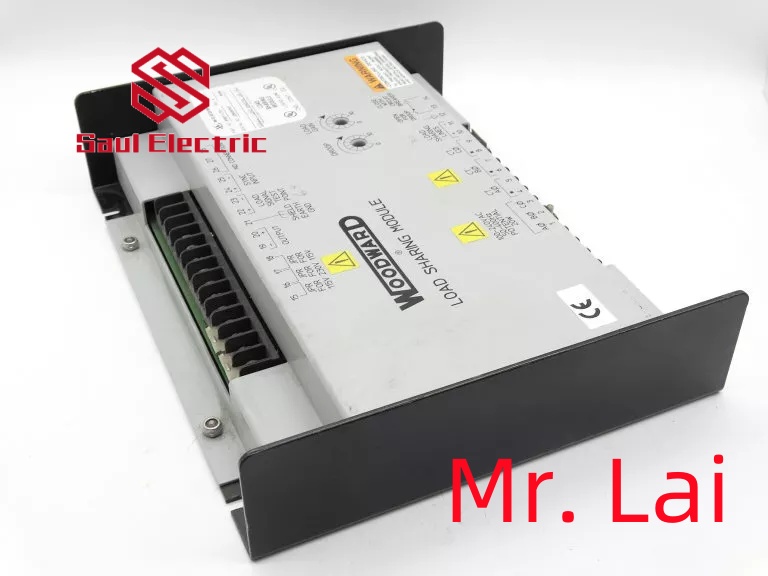
Woodward 5461-776 from SAUL ELECTRIC | In Stock
1.5461-776 Product Overview

The Woodward 5461-776 belongs to the 505/505E series digital turbine controllers. It is a microprocessor-based control module designed for single-valve steam turbines,
including single extraction/admission systems or split-range actuator configurations.
The controller features a front panel Operator Control Panel (OCP) with a two-line, 24-character display and multi-function keypad, allowing easy on-site configuration and monitoring.
2. 5461-776 Technical Specifications and Parameters
| Parameter | Details |
|---|---|
| Power Supply | +24 VDC, approx. 1 A |
| I/O Outputs | Discrete Outputs: 8 Analog Outputs: 6 Actuator Outputs: 2 |
| Display / HMI | Two-line, 24-character LCD, with multi-function keypad |
| Dimensions | Approx. 14 × 11 × 4 in (35.6 × 27.9 × 10.2 cm) |
| Weight | Approx. 9.11 lbs (4.13 kg) |
| Operating Temperature | –4 to +140 °F (–20 to +60 °C) |
| Storage Temperature | –40 to +185 °F (–40 to +85 °C) |
| Humidity Standard | 95% RH at 20-55 °C for 48 hours without damage |
| Protection Class | Typically meets industrial dust and water protection standards |
| Communication Protocol | Supports Modbus, RS-232 / RS-422 serial interfaces |

3. Brand History
Woodward, Inc., founded in 1870 and headquartered in Fort Collins, Colorado, USA, is a global leader in energy control systems. The company has a long history of innovation in turbine control, engine management,
and power generation systems.
Woodward products are widely recognized for their reliability and precision in demanding industrial and power generation applications.
4. Applications in Industrial Automation
The 5461-776 plays a critical role in industrial automation and power generation environments:
- Steam Turbine Control: Manages startup, speed regulation, and extraction/admission control of steam turbines.
- Power Generation Systems: Used in power plants to regulate turbine-driven generators for stable frequency and load management.
- Compressor and Pump Drive Control: Ensures precise speed control for turbine-driven compressors and pumps.
- Process Industry Applications: Applied in chemical plants, refineries, and other industries requiring precise turbine operation.
- Safety and Protection Functions: Includes overspeed protection, critical speed avoidance, actuator travel limits, and event logging for operational safety.

The starter kit can be obtained from manufacturers like Parallax or suppliers like Jameco. If you have read articles
about door closing circuits and digital clocks, you will be familiar with Jameco company. You can order the “BASIC
Stamp D Starter Kit” (part number 27202) from Parallax, and the starter kit with part number 140089 from Jameco.
You will receive a Stamp (as shown below), programming cable, software, and operating instructions. The pricing for
both companies is $79. Sometimes, Parallax releases a special version of the starter kit called “Essential Basics, All in One”, which includes Scott Edward”s
book “Programming and Customizing the BASIC Stamp Computer” in addition to the aforementioned content.
The connection of Stamp is very easy. You just need to connect it to the parallel port of the computer, run a DOS
application to edit your BASIC program, and download the program to Stamp. Here is a screenshot of a typical editor
(selected from Scott Edward”s book):
Principles and Applications of Microcontrollers
To run the program in this editor, press the ALT+R key combination. The editor application will check the BASIC program
and then send the program to the EEPROM (electrically erasable read-only memory) on the Stamp via cable. Subsequently,
Stamp will execute the program. In this example,
the program generates a square wave on I/O pin 3. If there is a logic probe or LED (Light Emitting Diode) connected to pin 3,
you will see that the LED lights up and goes out twice per second, because it changes state every 250 milliseconds according
to the PAUSE command. For detailed information on LED, please refer to the article on door closing circuits. A 9-volt dry battery can
run this program for several weeks. Shortening the time when the LED is in the on state (such as 50 milliseconds on and 450
milliseconds off), or using the NAP r command instead of the PAUSE command, can save energy.


There are no reviews yet.