

Woodward 5462-085 Price Discount | In Stock
1.5462-085 Product Overview

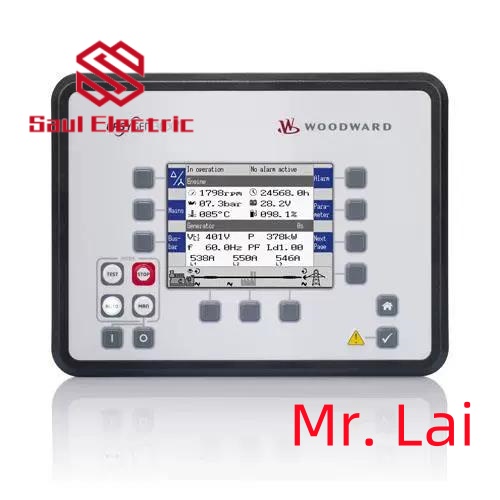
The Woodward 5462-085 belongs to the 505/505E series digital turbine controllers. It is a microprocessor-based control module designed for single-valve steam turbines,
including single extraction/admission systems or split-range actuator configurations.
The controller features a front panel Operator Control Panel (OCP) with a two-line, 24-character display and multi-function keypad, allowing easy on-site configuration and monitoring.
2. 5462-085 Technical Specifications and Parameters
| Parameter | Details |
|---|---|
| Power Supply | +24 VDC, approx. 1 A |
| I/O Outputs | Discrete Outputs: 8 Analog Outputs: 6 Actuator Outputs: 2 |
| Display / HMI | Two-line, 24-character LCD, with multi-function keypad |
| Dimensions | Approx. 14 × 11 × 4 in (35.6 × 27.9 × 10.2 cm) |
| Weight | Approx. 9.11 lbs (4.13 kg) |
| Operating Temperature | –4 to +140 °F (–20 to +60 °C) |
| Storage Temperature | –40 to +185 °F (–40 to +85 °C) |
| Humidity Standard | 95% RH at 20-55 °C for 48 hours without damage |
| Protection Class | Typically meets industrial dust and water protection standards |
| Communication Protocol | Supports Modbus, RS-232 / RS-422 serial interfaces |

3. Brand History
Woodward, Inc., founded in 1870 and headquartered in Fort Collins, Colorado, USA, is a global leader in energy control systems. The company has a long history of innovation in turbine control, engine management,
and power generation systems.
Woodward products are widely recognized for their reliability and precision in demanding industrial and power generation applications.
4. Applications in Industrial Automation
The 5462-085 plays a critical role in industrial automation and power generation environments:
- Steam Turbine Control: Manages startup, speed regulation, and extraction/admission control of steam turbines.
- Power Generation Systems: Used in power plants to regulate turbine-driven generators for stable frequency and load management.
- Compressor and Pump Drive Control: Ensures precise speed control for turbine-driven compressors and pumps.
- Process Industry Applications: Applied in chemical plants, refineries, and other industries requiring precise turbine operation.
- Safety and Protection Functions: Includes overspeed protection, critical speed avoidance, actuator travel limits, and event logging for operational safety.

For lower gate drivers, the 0.4 ohm impedance of the driver can keep the gate of the power MOSFET below the threshold level to ensure that no
through current occurs during high dV/dT phase node transitions. The internal diode charging bootstrap capacitor enables the device to use
N-channel MOSFETs in a half bridge configuration. The tri state pulse width modulation (PWM) input provided by TPS28225 is compatible with all multi-phase controllers
such as TITPS40091. The power-off mode can protect the load from the influence of reverse output voltage.
The TPS28225 MOSFET driver is now in mass production and can be ordered through TI and its authorized distributors. This device is available in two packaging versions:
a low-cost 8-pin SOICDFN package and a heat dissipation enhanced 3mm x 3mm 8-pin DFN package.
IR2117 is a gate driver integrated circuit designed by IR Corporation in the United States specifically for driving individual MOSFETs or IGBTs. IR2117 is a
gate driver designed by IR Corporation in the United States specifically for driving single MOSFETs or IGBTs. It uses high-voltage integrated circuit technology
and latch free CMOS technology, and adopts a dual in-line package, which can be used in systems with working bus voltages up to 600V. Its input is compatible
with standard CMOS levels, and its output driving
characteristics can meet the design requirements of high current driven output stages with the shortest cross conduction time. The application of its floating
channel and bootstrap technology allows it to be directly used to drive an N-channel MOSFET or IGBT that operates on the high or low side with a bus voltage of up to 600V.
2. Internal structure and working principle
The internal structure and working principle diagram of IR2117 are shown in Figure 2. It integrates nine unit circuits internally, including a Schmitt trigger, a pulse gain circuit,
two undervoltage detection and protection circuits, a level shift network, a NAND gate, a complementary power amplifier output stage composed of two MOSFETs, an RS trigger, and a pulse filter.
During normal operation, if the logic power supply and output power supply of IR2127 are not under voltage, the signal from the user controlled pulse forming unit is first shaped
by a Schmitt trigger, then amplified by a pulse gain loop, and level shifted and matched by a level shift network. After being triggered by an RS trigger, it is output by a complementary
push-pull output stage to drive an external MOSFET or IGBT. Once either the input logic power supply or the output amplifier stage floating power supply experiences undervoltage,
one of the output signals will be blocked, causing the output drive pulse to become low level.




There are no reviews yet.