

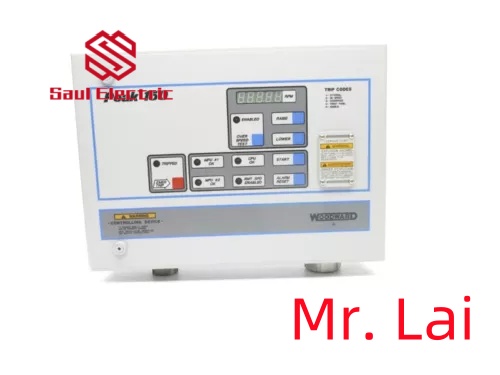
Woodward 5462-718 505 Turbine Control | 100% Original
1.5462-718 Product Overview

The Woodward 5462-718 belongs to the 505/505E series digital turbine controllers. It is a microprocessor-based control module designed for single-valve steam turbines,
including single extraction/admission systems or split-range actuator configurations.
The controller features a front panel Operator Control Panel (OCP) with a two-line, 24-character display and multi-function keypad, allowing easy on-site configuration and monitoring.
2. 5462-718 Technical Specifications and Parameters
| Parameter | Details |
|---|---|
| Power Supply | +24 VDC, approx. 1 A |
| I/O Outputs | Discrete Outputs: 8 Analog Outputs: 6 Actuator Outputs: 2 |
| Display / HMI | Two-line, 24-character LCD, with multi-function keypad |
| Dimensions | Approx. 14 × 11 × 4 in (35.6 × 27.9 × 10.2 cm) |
| Weight | Approx. 9.11 lbs (4.13 kg) |
| Operating Temperature | –4 to +140 °F (–20 to +60 °C) |
| Storage Temperature | –40 to +185 °F (–40 to +85 °C) |
| Humidity Standard | 95% RH at 20-55 °C for 48 hours without damage |
| Protection Class | Typically meets industrial dust and water protection standards |
| Communication Protocol | Supports Modbus, RS-232 / RS-422 serial interfaces |

3. Brand History
Woodward, Inc., founded in 1870 and headquartered in Fort Collins, Colorado, USA, is a global leader in energy control systems. The company has a long history of innovation in turbine control, engine management,
and power generation systems.
Woodward products are widely recognized for their reliability and precision in demanding industrial and power generation applications.
4. Applications in Industrial Automation
The 5462-718 plays a critical role in industrial automation and power generation environments:
- Steam Turbine Control: Manages startup, speed regulation, and extraction/admission control of steam turbines.
- Power Generation Systems: Used in power plants to regulate turbine-driven generators for stable frequency and load management.
- Compressor and Pump Drive Control: Ensures precise speed control for turbine-driven compressors and pumps.
- Process Industry Applications: Applied in chemical plants, refineries, and other industries requiring precise turbine operation.
- Safety and Protection Functions: Includes overspeed protection, critical speed avoidance, actuator travel limits, and event logging for operational safety.

Explanation: 1. SRV-CTRL refers to the servo control module of PLC;
2. Take the → pointer as input and the ← pointer as output.
3. The meanings of each signal are as follows:
INH: Prohibit input of pulse commands (prohibited when open circuit);
OZ -: Z-phase output;
OZ+: Z-phase output;
S-RDY: The servo drive is ready;
ALM: Servo drive fault alarm;
COIN: Positioning completed;
SRV-ON: servo drive “on” signal;
COM -: Negative pole of power supply;
COM+: Positive pole of power supply;
PULS1: Command pulse input terminal;
PULS2: Command pulse input terminal;
SIGN1: Command pulse symbol input terminal;
SIGN2: Command pulse symbol input terminal;
Servo Drive Wiring Guide
In the field of industrial control automation, many devices have strict installation specifications. So, in order to avoid usage
risks and eliminate safety hazards, what are the rules for connecting servo drives?
1. It is recommended to use a three-phase isolation transformer for power supply to reduce the possibility of electric shock.
2. It is recommended to use a noise filter for power supply to improve anti-interference ability.
3. Please install a non melting short-circuit circuit breaker to promptly cut off external power in case of driver failure.
4. The grounding wire should be ≥ 2.5m2, as thick as possible, and made into a single point grounding.
The grounding terminal of the servo motor must be connected to the grounding terminal PE of the driver.
5. Connect the shielding layer of the cable correctly.
To prevent interference and misoperation, it is recommended to install a noise filter and pay attention to:
(1) The noise filter, servo drive, and upper controller should be installed as close as possible.
(2) Surge suppressors must be installed in relays, AC contactors, brakes, and other coils.
(3) Power circuit cables and signal lines should not be tied together.



There are no reviews yet.