

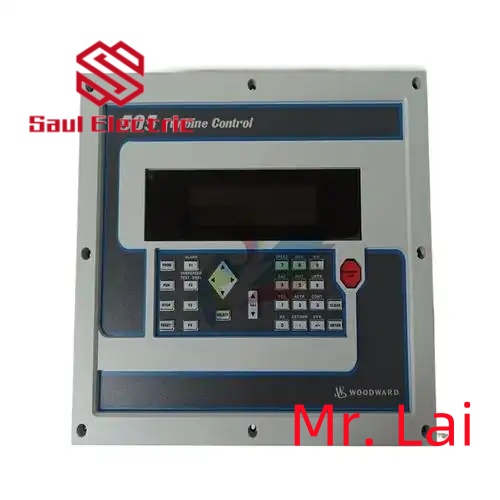
Woodward 5463-388 |CPU Module, Origin: United States
1.5463-388 Product Overview

The Woodward 5463-388 belongs to the 505/505E series digital turbine controllers. It is a microprocessor-based control module designed for single-valve steam turbines,
including single extraction/admission systems or split-range actuator configurations.
The controller features a front panel Operator Control Panel (OCP) with a two-line, 24-character display and multi-function keypad, allowing easy on-site configuration and monitoring.
2. 5463-388 Technical Specifications and Parameters
| Parameter | Details |
|---|---|
| Power Supply | +24 VDC, approx. 1 A |
| I/O Outputs | Discrete Outputs: 8 Analog Outputs: 6 Actuator Outputs: 2 |
| Display / HMI | Two-line, 24-character LCD, with multi-function keypad |
| Dimensions | Approx. 14 × 11 × 4 in (35.6 × 27.9 × 10.2 cm) |
| Weight | Approx. 9.11 lbs (4.13 kg) |
| Operating Temperature | –4 to +140 °F (–20 to +60 °C) |
| Storage Temperature | –40 to +185 °F (–40 to +85 °C) |
| Humidity Standard | 95% RH at 20-55 °C for 48 hours without damage |
| Protection Class | Typically meets industrial dust and water protection standards |
| Communication Protocol | Supports Modbus, RS-232 / RS-422 serial interfaces |

3. Brand History
Woodward, Inc., founded in 1870 and headquartered in Fort Collins, Colorado, USA, is a global leader in energy control systems. The company has a long history of innovation in turbine control, engine management,
and power generation systems.
Woodward products are widely recognized for their reliability and precision in demanding industrial and power generation applications.
4. Applications in Industrial Automation
The 5463-388 plays a critical role in industrial automation and power generation environments:
- Steam Turbine Control: Manages startup, speed regulation, and extraction/admission control of steam turbines.
- Power Generation Systems: Used in power plants to regulate turbine-driven generators for stable frequency and load management.
- Compressor and Pump Drive Control: Ensures precise speed control for turbine-driven compressors and pumps.
- Process Industry Applications: Applied in chemical plants, refineries, and other industries requiring precise turbine operation.
- Safety and Protection Functions: Includes overspeed protection, critical speed avoidance, actuator travel limits, and event logging for operational safety.

How to repair PLC controller
PLC controllers usually consist of two parts: hardware and software, so these two aspects need to be considered when repairing PLC controllers.
Hardware maintenance:
Check power supply: Check whether the power supply of the PLC controller is normal, including whether the input voltage is stable,
whether the power cord is plugged in properly, and whether the power switch is turned on.
Check input/output module: Check if the input/output module is plugged in properly and if the signal lines are connected correctly.
Replace faulty components: Based on the fault symptoms and possible causes, replace corresponding components such as capacitors, resistors, relays, etc.
Cleaning internal components: Clean the components inside the PLC controller to prevent component aging, contamination, and corrosion.
Software maintenance:
Check the program: Check whether the PLC controller program is correct, including whether the instructions are incorrect,
whether the logical relationships are correct, etc.
Replace program memory: If the program memory fails, you can try replacing it with a new one.
Reinstall program: If the program encounters serious errors, you can try reinstalling the program.
Clean up storage: Clean up useless data and programs in the storage to free up storage space.
When repairing a PLC controller, it is necessary to first understand the fault symptoms and possible causes, and then gradually
eliminate the possible fault points. If you are unable to solve the problem on your own, you can seek professional technical support or repair services.


There are no reviews yet.