

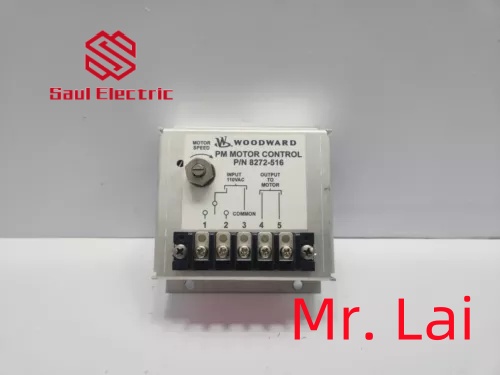
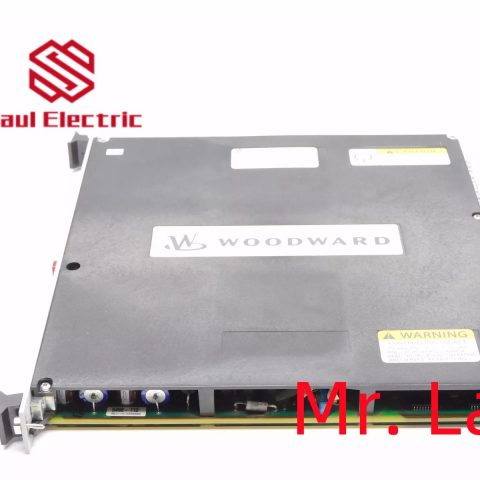
Woodward 5464-114 505 Turbine Control | 100% Original
1.5464-114 Product Overview

The Woodward 5464-114 belongs to the 505/505E series digital turbine controllers. It is a microprocessor-based control module designed for single-valve steam turbines,
including single extraction/admission systems or split-range actuator configurations.
The controller features a front panel Operator Control Panel (OCP) with a two-line, 24-character display and multi-function keypad, allowing easy on-site configuration and monitoring.
2. 5464-114 Technical Specifications and Parameters
| Parameter | Details |
|---|---|
| Power Supply | +24 VDC, approx. 1 A |
| I/O Outputs | Discrete Outputs: 8 Analog Outputs: 6 Actuator Outputs: 2 |
| Display / HMI | Two-line, 24-character LCD, with multi-function keypad |
| Dimensions | Approx. 14 × 11 × 4 in (35.6 × 27.9 × 10.2 cm) |
| Weight | Approx. 9.11 lbs (4.13 kg) |
| Operating Temperature | –4 to +140 °F (–20 to +60 °C) |
| Storage Temperature | –40 to +185 °F (–40 to +85 °C) |
| Humidity Standard | 95% RH at 20-55 °C for 48 hours without damage |
| Protection Class | Typically meets industrial dust and water protection standards |
| Communication Protocol | Supports Modbus, RS-232 / RS-422 serial interfaces |

3. Brand History
Woodward, Inc., founded in 1870 and headquartered in Fort Collins, Colorado, USA, is a global leader in energy control systems. The company has a long history of innovation in turbine control, engine management,
and power generation systems.
Woodward products are widely recognized for their reliability and precision in demanding industrial and power generation applications.
4. Applications in Industrial Automation
The 5464-114 plays a critical role in industrial automation and power generation environments:
- Steam Turbine Control: Manages startup, speed regulation, and extraction/admission control of steam turbines.
- Power Generation Systems: Used in power plants to regulate turbine-driven generators for stable frequency and load management.
- Compressor and Pump Drive Control: Ensures precise speed control for turbine-driven compressors and pumps.
- Process Industry Applications: Applied in chemical plants, refineries, and other industries requiring precise turbine operation.
- Safety and Protection Functions: Includes overspeed protection, critical speed avoidance, actuator travel limits, and event logging for operational safety.

What is a SCSI controller
What is a SCSI controller
The English name for SCSI is “Small Computer System Interface”, which is translated as “Small Computer System Specific Interface” in Chinese;
As the name suggests, this is an expansion interface designed for small computers, which allows computers to install other peripheral devices to
improve system performance or add new features, such as hard drives, optical drives, scanners, etc.
Early computers were classified into various levels based on speed and functionality, including mainframes, small computers, and microcomputers.
Some small workstations and servers were classified as small computers, while personal computers were classified as microcomputers; Therefore,
at that time, the models that used SCSI interfaces were mainly mid to high end devices such as workstations and servers. In recent years, due to the
significant increase in personal computer performance and expansion requirements, the application of SCSI in PCs (ordinary microcomputers) has also been increasing.
In fact, SCSI is not a new interface type. It has been almost 20 years since someone noticed the issue of extending the functionality of small computers,
started developing new unified expansion interfaces, and officially established the SCSI standard in 1986. In the early days, Apple was the first to select SCSI
as the standard interface for Macs computers, and many peripherals were connected to the main system through this unified interface. On the PC side, SCSI
interface cards and devices are expensive, and almost all peripherals have cheaper interfaces to replace them, so SCSI is not favored; On the other hand,
there are not many available SCSI devices. On the other hand, today”s peripheral products that support SCSI interface have expanded from only hard drives and tape
drives to various devices such as scanners, optical drives, burners, MOs, etc. The opportunities for people to come into contact with SCSI are gradually increasing; In addition,
with the advancement of manufacturing technology, the prices of SCSI cards and peripherals are no longer high, indicating that the SCSI market has become quite mature.


There are no reviews yet.