

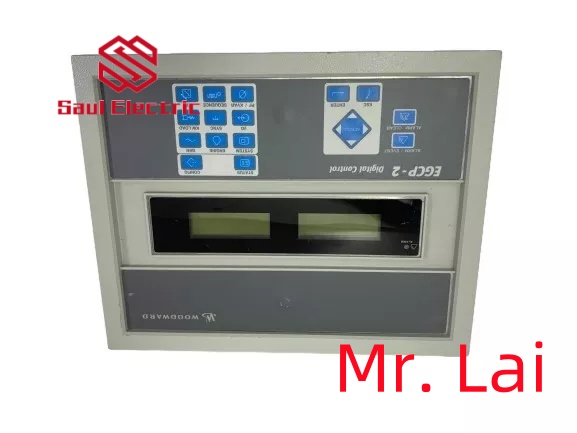
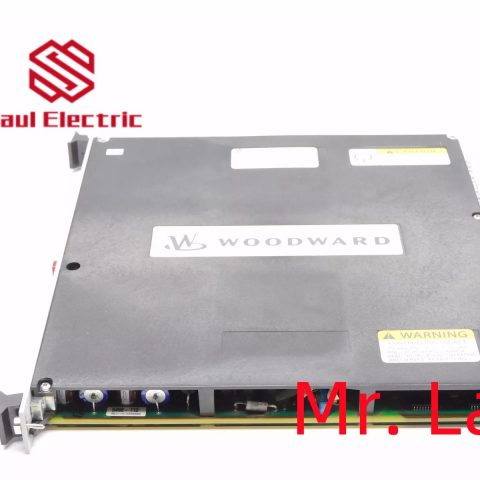
Woodward 5464-330 from SAUL ELECTRIC | In Stock
1.5464-330 Product Overview

The Woodward 5464-330 belongs to the 505/505E series digital turbine controllers. It is a microprocessor-based control module designed for single-valve steam turbines,
including single extraction/admission systems or split-range actuator configurations.
The controller features a front panel Operator Control Panel (OCP) with a two-line, 24-character display and multi-function keypad, allowing easy on-site configuration and monitoring.
2. 5464-330 Technical Specifications and Parameters
| Parameter | Details |
|---|---|
| Power Supply | +24 VDC, approx. 1 A |
| I/O Outputs | Discrete Outputs: 8 Analog Outputs: 6 Actuator Outputs: 2 |
| Display / HMI | Two-line, 24-character LCD, with multi-function keypad |
| Dimensions | Approx. 14 × 11 × 4 in (35.6 × 27.9 × 10.2 cm) |
| Weight | Approx. 9.11 lbs (4.13 kg) |
| Operating Temperature | –4 to +140 °F (–20 to +60 °C) |
| Storage Temperature | –40 to +185 °F (–40 to +85 °C) |
| Humidity Standard | 95% RH at 20-55 °C for 48 hours without damage |
| Protection Class | Typically meets industrial dust and water protection standards |
| Communication Protocol | Supports Modbus, RS-232 / RS-422 serial interfaces |

3. Brand History
Woodward, Inc., founded in 1870 and headquartered in Fort Collins, Colorado, USA, is a global leader in energy control systems. The company has a long history of innovation in turbine control, engine management,
and power generation systems.
Woodward products are widely recognized for their reliability and precision in demanding industrial and power generation applications.
4. Applications in Industrial Automation
The 5464-330 plays a critical role in industrial automation and power generation environments:
- Steam Turbine Control: Manages startup, speed regulation, and extraction/admission control of steam turbines.
- Power Generation Systems: Used in power plants to regulate turbine-driven generators for stable frequency and load management.
- Compressor and Pump Drive Control: Ensures precise speed control for turbine-driven compressors and pumps.
- Process Industry Applications: Applied in chemical plants, refineries, and other industries requiring precise turbine operation.
- Safety and Protection Functions: Includes overspeed protection, critical speed avoidance, actuator travel limits, and event logging for operational safety.

What is a host controller?
What is a host controller?
When developing specifications, we should ensure that there is only one host in any USB system. The USB specification is not intended as
a network architecture, its purpose is to achieve simple interconnection from peripherals to PCs. A host can be a combination of hardware, firmware,
or software. The most common USB host implementation scheme in computers currently is part of the so-called core logic chipset. This
host controller device adopts the computing function of PC CPU, supports data storage and movement with system
memory, and is implemented as a whole through PC operating system. All hosts must integrate a root hub into the system. The host is mainly responsible for the following tasks:
Detecting the external connection and removal of USB devices
Control process between management host and USB devices
Manage the data flow between the host and USB devices
Collect status and activity data
Power supply for external USB devices
USB system software
Manage the interaction between hosts and devices in the following five aspects
Equipment List and Configuration
Synchronous data transmission
Asynchronous data transfer
power management
Equipment and bus management information
Most operating systems now include a series of “class drivers” that facilitate the connection of peripherals. Class drivers
enable peripheral manufacturers to provide products with native support for operating system software, thereby saving the
cost of developing drivers and providing drivers for new host systems. Moreover, after the launch of new storage devices,
peripherals can directly support drivers. Most operating systems support some common class drivers, including audio
class, Human Interface Device (HID) class, imaging class, mass storage class, printer class, and video class. At present,
many manufacturers use the above-mentioned class drivers to implement product functions, but they also provide customized
drivers or application software to support more functions beyond the class driver specification.


There are no reviews yet.