

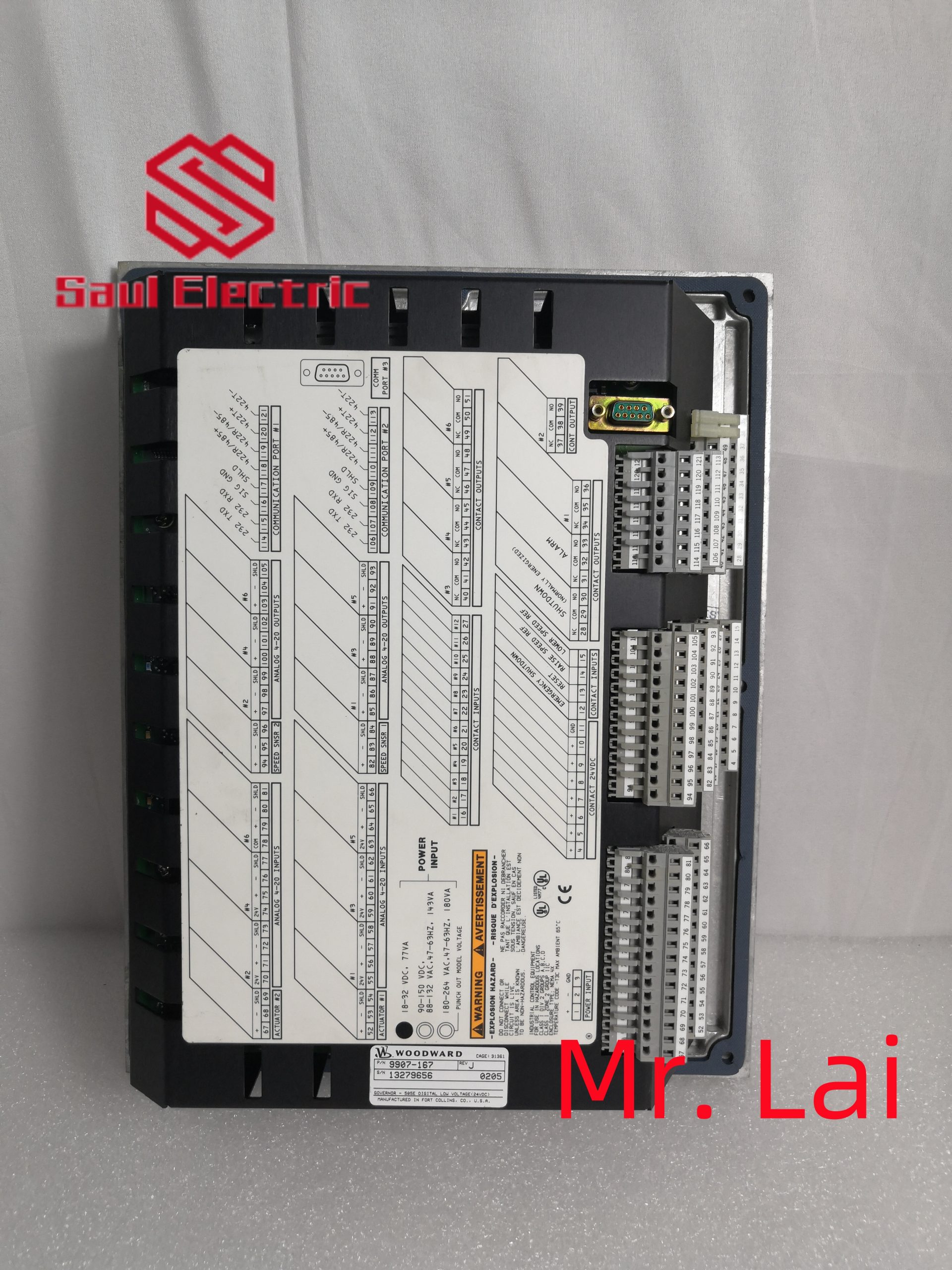
Woodward 5464-654 from SAUL ELECTRIC | In Stock
1.5464-654 Product Overview

The Woodward 5464-654 belongs to the 505/505E series digital turbine controllers. It is a microprocessor-based control module designed for single-valve steam turbines,
including single extraction/admission systems or split-range actuator configurations.
The controller features a front panel Operator Control Panel (OCP) with a two-line, 24-character display and multi-function keypad, allowing easy on-site configuration and monitoring.
2. 5464-654 Technical Specifications and Parameters
| Parameter | Details |
|---|---|
| Power Supply | +24 VDC, approx. 1 A |
| I/O Outputs | Discrete Outputs: 8 Analog Outputs: 6 Actuator Outputs: 2 |
| Display / HMI | Two-line, 24-character LCD, with multi-function keypad |
| Dimensions | Approx. 14 × 11 × 4 in (35.6 × 27.9 × 10.2 cm) |
| Weight | Approx. 9.11 lbs (4.13 kg) |
| Operating Temperature | –4 to +140 °F (–20 to +60 °C) |
| Storage Temperature | –40 to +185 °F (–40 to +85 °C) |
| Humidity Standard | 95% RH at 20-55 °C for 48 hours without damage |
| Protection Class | Typically meets industrial dust and water protection standards |
| Communication Protocol | Supports Modbus, RS-232 / RS-422 serial interfaces |

3. Brand History
Woodward, Inc., founded in 1870 and headquartered in Fort Collins, Colorado, USA, is a global leader in energy control systems. The company has a long history of innovation in turbine control, engine management,
and power generation systems.
Woodward products are widely recognized for their reliability and precision in demanding industrial and power generation applications.
4. Applications in Industrial Automation
The 5464-654 plays a critical role in industrial automation and power generation environments:
- Steam Turbine Control: Manages startup, speed regulation, and extraction/admission control of steam turbines.
- Power Generation Systems: Used in power plants to regulate turbine-driven generators for stable frequency and load management.
- Compressor and Pump Drive Control: Ensures precise speed control for turbine-driven compressors and pumps.
- Process Industry Applications: Applied in chemical plants, refineries, and other industries requiring precise turbine operation.
- Safety and Protection Functions: Includes overspeed protection, critical speed avoidance, actuator travel limits, and event logging for operational safety.

How to choose a microcontroller?
Choosing the right microcontroller for a product can be a daunting task. You not only need to consider many technical features,
but also business aspects such as cost and stocking time that may weaken the project.
In the early stages of a project, you may have an immediate urge to start choosing a microcontroller before agreeing on the details
of the system, which is certainly a bad idea.
Before any thinking about microcontrollers, hardware and software engineers should first develop high-level specifications for the system,
draw diagrams and flowcharts, and only then have sufficient information to make rational decisions about microcontroller selection. At this stage,
you can follow 10 simple steps to ensure making the right choice.
Step 1: Develop a list of required hardware interfaces
Develop a list of all external interfaces that the microcontroller needs to support using the overall hardware diagram. There are generally
two types of interfaces that need to be listed. The first type of interface is the communication interface, which includes peripheral interfaces such as USB, I2C, SPI, and UART.
If the application requires USB or some form of Ethernet, make a special note. These interfaces have a significant impact on the program
space size that microcontrollers need to support. The second type of interface includes digital input and output, analog-to-digital input, and PWM interface.
These two interface types will indicate the number of pins required by the microcontroller. Figure 1 shows a general example block diagram that lists the I/O requirements.


There are no reviews yet.