

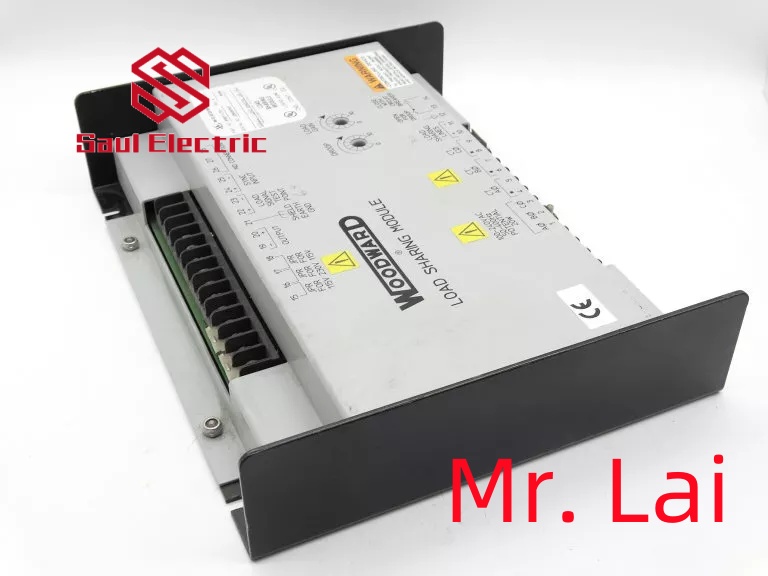
Woodward 5466-341 |CPU Module, Origin: United States
1.5466-341 Product Overview

The Woodward 5466-341 belongs to the 505/505E series digital turbine controllers. It is a microprocessor-based control module designed for single-valve steam turbines,
including single extraction/admission systems or split-range actuator configurations.
The controller features a front panel Operator Control Panel (OCP) with a two-line, 24-character display and multi-function keypad, allowing easy on-site configuration and monitoring.
2. 5466-341 Technical Specifications and Parameters
| Parameter | Details |
|---|---|
| Power Supply | +24 VDC, approx. 1 A |
| I/O Outputs | Discrete Outputs: 8 Analog Outputs: 6 Actuator Outputs: 2 |
| Display / HMI | Two-line, 24-character LCD, with multi-function keypad |
| Dimensions | Approx. 14 × 11 × 4 in (35.6 × 27.9 × 10.2 cm) |
| Weight | Approx. 9.11 lbs (4.13 kg) |
| Operating Temperature | –4 to +140 °F (–20 to +60 °C) |
| Storage Temperature | –40 to +185 °F (–40 to +85 °C) |
| Humidity Standard | 95% RH at 20-55 °C for 48 hours without damage |
| Protection Class | Typically meets industrial dust and water protection standards |
| Communication Protocol | Supports Modbus, RS-232 / RS-422 serial interfaces |

3. Brand History
Woodward, Inc., founded in 1870 and headquartered in Fort Collins, Colorado, USA, is a global leader in energy control systems. The company has a long history of innovation in turbine control, engine management,
and power generation systems.
Woodward products are widely recognized for their reliability and precision in demanding industrial and power generation applications.
4. Applications in Industrial Automation
The 5466-341 plays a critical role in industrial automation and power generation environments:
- Steam Turbine Control: Manages startup, speed regulation, and extraction/admission control of steam turbines.
- Power Generation Systems: Used in power plants to regulate turbine-driven generators for stable frequency and load management.
- Compressor and Pump Drive Control: Ensures precise speed control for turbine-driven compressors and pumps.
- Process Industry Applications: Applied in chemical plants, refineries, and other industries requiring precise turbine operation.
- Safety and Protection Functions: Includes overspeed protection, critical speed avoidance, actuator travel limits, and event logging for operational safety.

What is PID controller and its applications
PID controller, also known as Proportional Integral Derivative Controller, is an extremely important control algorithm in the field
of industrial control. It consists of three basic parts: proportional unit (P), integral unit (I), and differential unit (D), and precise control
of the controlled object is achieved by adjusting the parameters (Kp, Ki, Kd) of these three parts.
The principle of PID controller
The core idea of PID controller is to predict the future state based on the current state (i.e. deviation) and past state (i.e. integral
and derivative of deviation) of the system, and adjust the control quantity accordingly, so that the
system output can quickly and accurately track the set value. Specifically:
Proportional (P) control: Generate corresponding control effects based on the size of the error, and the larger the error,
the stronger the control effect. Proportional control can quickly respond to errors and reduce steady-state errors,
but cannot eliminate steady-state errors.
Integral (I) control: Integrating errors to eliminate static errors (i.e. steady-state errors). As long as there is an error,
the integral controller continuously accumulates the output control quantity until the error is zero. Excessive integration
can lead to increased overshoot and even oscillation in the system.
Differential (D) control: Reflecting the trend of error changes and generating control effects in advance. Differential
control can reduce overshoot, overcome oscillations, improve system stability, and accelerate the dynamic response speed of the system.


There are no reviews yet.