

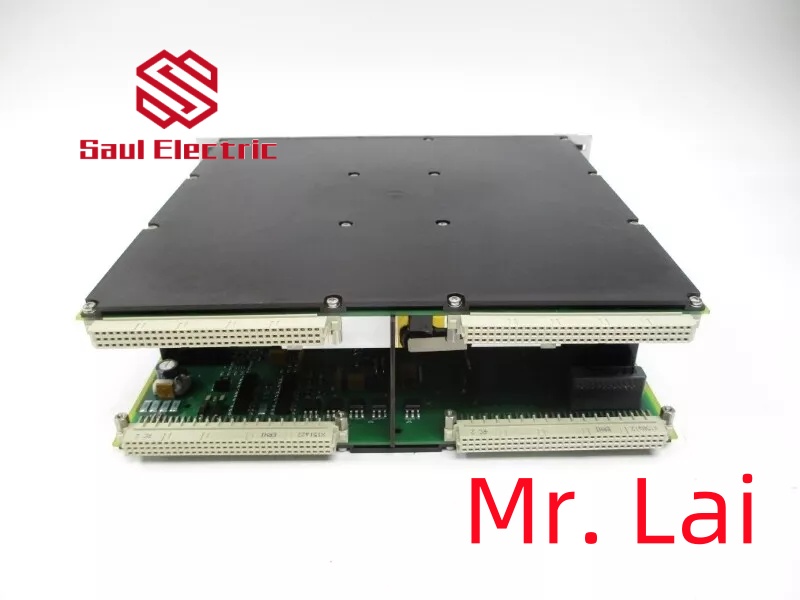
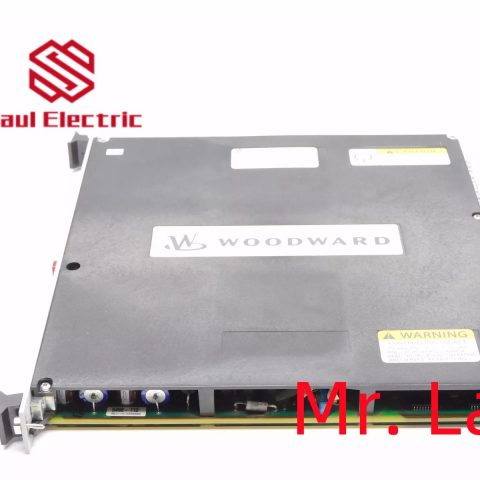
Woodward 5501-341 Price Discount | In Stock
1.5501-341 Product Overview

The Woodward 5501-341 belongs to the 505/505E series digital turbine controllers. It is a microprocessor-based control module designed for single-valve steam turbines,
including single extraction/admission systems or split-range actuator configurations.
The controller features a front panel Operator Control Panel (OCP) with a two-line, 24-character display and multi-function keypad, allowing easy on-site configuration and monitoring.
2. 5501-341 Technical Specifications and Parameters
| Parameter | Details |
|---|---|
| Power Supply | +24 VDC, approx. 1 A |
| I/O Outputs | Discrete Outputs: 8 Analog Outputs: 6 Actuator Outputs: 2 |
| Display / HMI | Two-line, 24-character LCD, with multi-function keypad |
| Dimensions | Approx. 14 × 11 × 4 in (35.6 × 27.9 × 10.2 cm) |
| Weight | Approx. 9.11 lbs (4.13 kg) |
| Operating Temperature | –4 to +140 °F (–20 to +60 °C) |
| Storage Temperature | –40 to +185 °F (–40 to +85 °C) |
| Humidity Standard | 95% RH at 20-55 °C for 48 hours without damage |
| Protection Class | Typically meets industrial dust and water protection standards |
| Communication Protocol | Supports Modbus, RS-232 / RS-422 serial interfaces |

3. Brand History
Woodward, Inc., founded in 1870 and headquartered in Fort Collins, Colorado, USA, is a global leader in energy control systems. The company has a long history of innovation in turbine control, engine management,
and power generation systems.
Woodward products are widely recognized for their reliability and precision in demanding industrial and power generation applications.
4. Applications in Industrial Automation
The 5501-341 plays a critical role in industrial automation and power generation environments:
- Steam Turbine Control: Manages startup, speed regulation, and extraction/admission control of steam turbines.
- Power Generation Systems: Used in power plants to regulate turbine-driven generators for stable frequency and load management.
- Compressor and Pump Drive Control: Ensures precise speed control for turbine-driven compressors and pumps.
- Process Industry Applications: Applied in chemical plants, refineries, and other industries requiring precise turbine operation.
- Safety and Protection Functions: Includes overspeed protection, critical speed avoidance, actuator travel limits, and event logging for operational safety.

Motor driver solutions and building drivers from discrete components
Motor drivers are essential for controlling motors in all devices from office printers to fans. With the increasing complexity
of motor applications, the functionality of motor drivers is also expanding. Although using discrete components to assemble
motor drives has been effective in the past, more and more engineers are turning to complete motor drive solutions that are included on a single chip.
Understand motor drivers
The motor driver serves as the interface between the DC motor and its control circuit. These drivers receive low current signals from
the control circuit and amplify them to generate high current signals required to drive the motor. Over the years, various methods have
been used to create motor drivers, with H-bridge circuits being the most common. At least, the H-bridge driver can turn on and off the motor
and reverse its direction. However, for more advanced applications such as robot vacuum
cleaners and DSLR cameras, better control and circuit protection are needed.
Discrete component motor driver
The traditional method for motor drivers is to assemble them using discrete components, with the most common being the basic H-bridge.
The name “H-bridge” comes from the H-shaped configuration formed by four switches, which are the core of its functionality.
The basic H-bridge motor driver circuit typically includes four switches made of MOSFETs or P-channel and N-channel BJTs.
However, please remember that the described H-bridge components will constitute the minimum required for a simple driver program.
Due to the involvement of efficiency, noise, vibration,
circuit protection, and electromagnetic interference, motor driver circuits have become more complex, and engineers must also consider
input and output interfaces. In short, drivers for applications such as industrial printers or camera autofocus require more than just basic H-bridge functionality.


There are no reviews yet.