

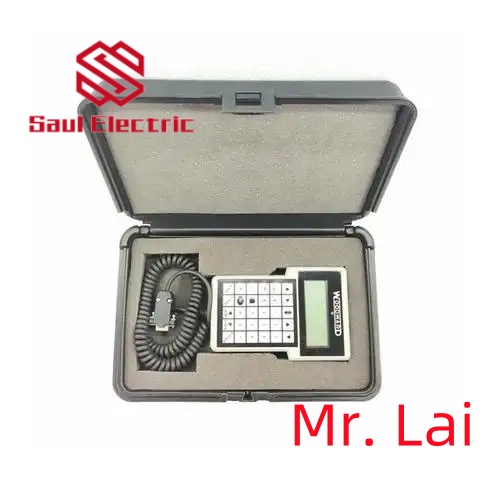
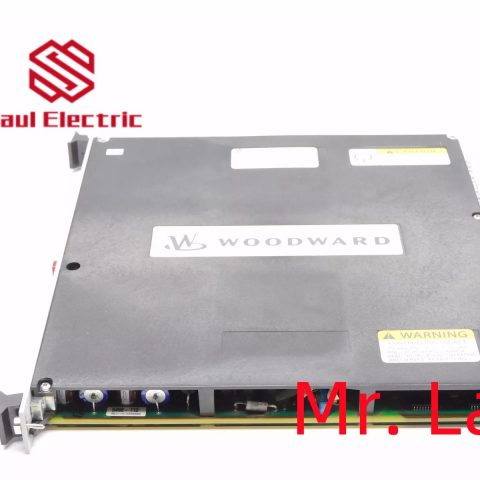
Woodward 8238-007 505 Turbine Control | 100% Original
1.8238-007 Product Overview

The Woodward 8238-007 belongs to the 505/505E series digital turbine controllers. It is a microprocessor-based control module designed for single-valve steam turbines,
including single extraction/admission systems or split-range actuator configurations.
The controller features a front panel Operator Control Panel (OCP) with a two-line, 24-character display and multi-function keypad, allowing easy on-site configuration and monitoring.
2. 8238-007 Technical Specifications and Parameters
| Parameter | Details |
|---|---|
| Power Supply | +24 VDC, approx. 1 A |
| I/O Outputs | Discrete Outputs: 8 Analog Outputs: 6 Actuator Outputs: 2 |
| Display / HMI | Two-line, 24-character LCD, with multi-function keypad |
| Dimensions | Approx. 14 × 11 × 4 in (35.6 × 27.9 × 10.2 cm) |
| Weight | Approx. 9.11 lbs (4.13 kg) |
| Operating Temperature | –4 to +140 °F (–20 to +60 °C) |
| Storage Temperature | –40 to +185 °F (–40 to +85 °C) |
| Humidity Standard | 95% RH at 20-55 °C for 48 hours without damage |
| Protection Class | Typically meets industrial dust and water protection standards |
| Communication Protocol | Supports Modbus, RS-232 / RS-422 serial interfaces |

3. Brand History
Woodward, Inc., founded in 1870 and headquartered in Fort Collins, Colorado, USA, is a global leader in energy control systems. The company has a long history of innovation in turbine control, engine management,
and power generation systems.
Woodward products are widely recognized for their reliability and precision in demanding industrial and power generation applications.
4. Applications in Industrial Automation
The 8238-007 plays a critical role in industrial automation and power generation environments:
- Steam Turbine Control: Manages startup, speed regulation, and extraction/admission control of steam turbines.
- Power Generation Systems: Used in power plants to regulate turbine-driven generators for stable frequency and load management.
- Compressor and Pump Drive Control: Ensures precise speed control for turbine-driven compressors and pumps.
- Process Industry Applications: Applied in chemical plants, refineries, and other industries requiring precise turbine operation.
- Safety and Protection Functions: Includes overspeed protection, critical speed avoidance, actuator travel limits, and event logging for operational safety.

Computers have some RAM (Random Access Memory) used to store “variables”.
In addition, computers also have some input and output devices so that they can exchange information with users. On your desktop computer, the keyboard
and mouse are input devices, while the monitor and printer are output devices. A hard drive is an input/output device – it can both input and output.
The desktop computer you are using is a “general-purpose computer” that can run thousands of various programs. Microcontrollers are specialized computers
used for special purposes. It focuses on doing one thing. Microcontrollers share many common characteristics.
If a computer has most of the following characteristics, then you can call it a “microcontroller”:
Microcontrollers are embedded within other devices (usually consumer products) to control the functionality and operation of the product.
Therefore, microcontrollers are also known as “embedded controllers”.
A microcontroller runs a specific program to accomplish a specialized task. This program is stored in ROM (Read Only Memory) and is generally not modified.
Microcontrollers are typically low-energy devices. The power plug of a desktop computer is almost always plugged into a wall socket, with a power
output of approximately 50 watts. The power of a battery powered microcontroller is approximately 0.05 watts.
Microcontrollers have a dedicated input device and typically (but not always) a light-emitting diode or liquid crystal display screen used as an output.
The microcontroller also obtains input signals from the devices it controls and controls the device by sending signals to different parts of the device.
For example, the microcontroller in a television receives input signals from a remote control and displays them on the screen. The microcontroller
controls the channel selector, speakers, and electronic adjustments such as color and brightness of the cathode ray tube. The engine controller in
a car receives input signals from sensors such as oxygen and detonation, and controls fuel mixing and spark plug timing. The microwave oven controller
obtains input signals from the operation keyboard, displays outputs on the LCD screen, and controls the relay responsible for the microwave generator switch.


There are no reviews yet.