

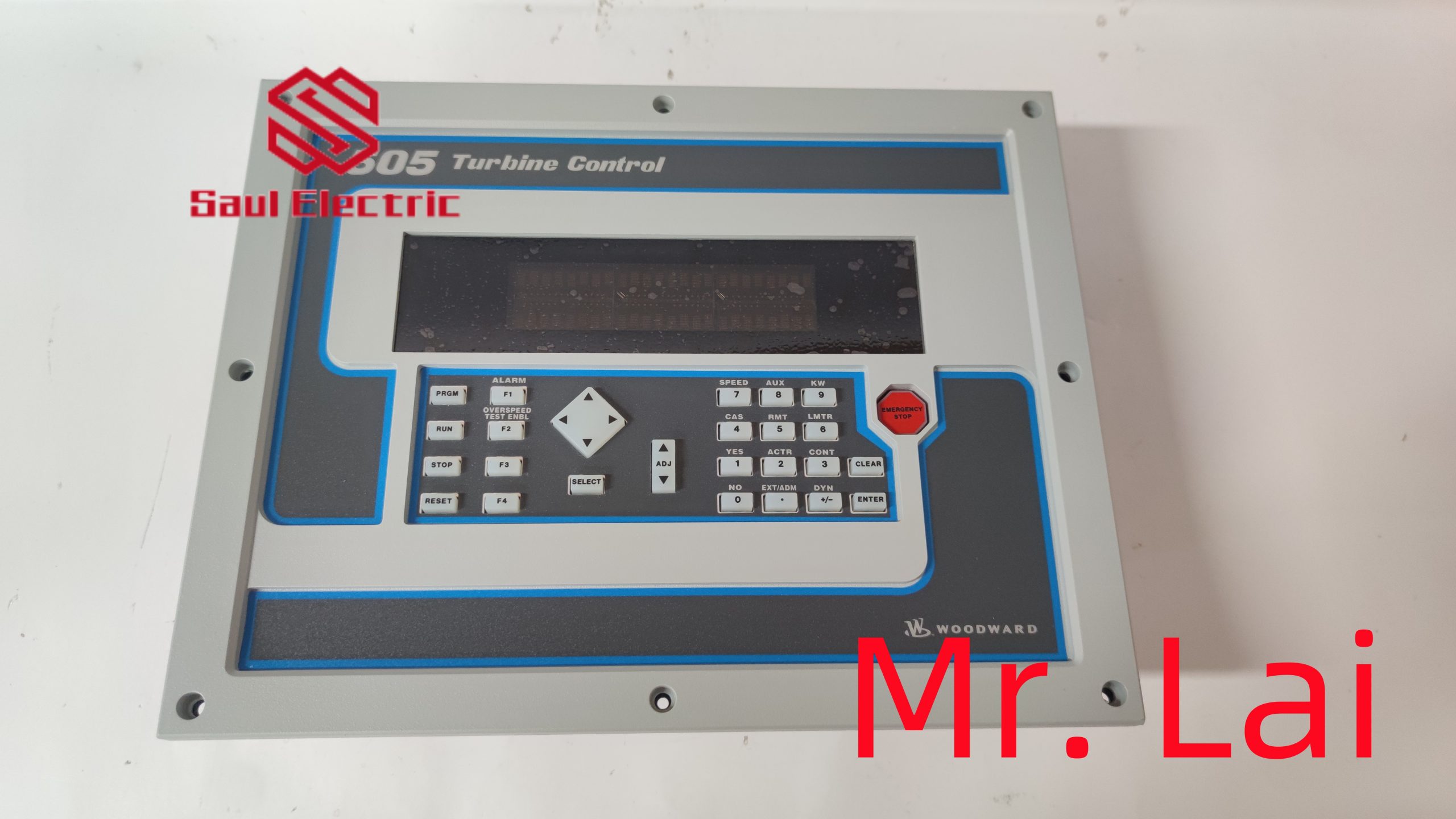
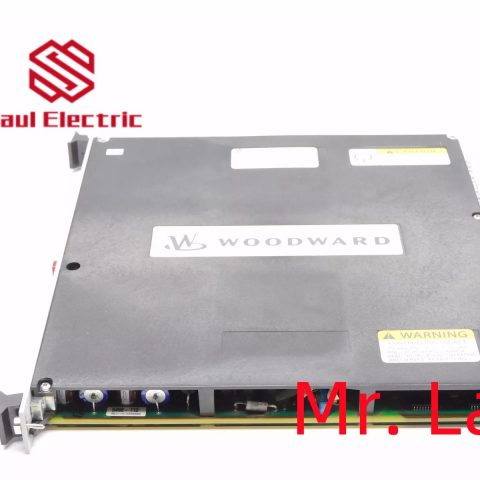
Woodward 8270-1082 505 Turbine Control | 100% Original
1.8270-1082 Product Overview

The Woodward 8270-1082 belongs to the 505/505E series digital turbine controllers. It is a microprocessor-based control module designed for single-valve steam turbines,
including single extraction/admission systems or split-range actuator configurations.
The controller features a front panel Operator Control Panel (OCP) with a two-line, 24-character display and multi-function keypad, allowing easy on-site configuration and monitoring.
2. 8270-1082 Technical Specifications and Parameters
| Parameter | Details |
|---|---|
| Power Supply | +24 VDC, approx. 1 A |
| I/O Outputs | Discrete Outputs: 8 Analog Outputs: 6 Actuator Outputs: 2 |
| Display / HMI | Two-line, 24-character LCD, with multi-function keypad |
| Dimensions | Approx. 14 × 11 × 4 in (35.6 × 27.9 × 10.2 cm) |
| Weight | Approx. 9.11 lbs (4.13 kg) |
| Operating Temperature | –4 to +140 °F (–20 to +60 °C) |
| Storage Temperature | –40 to +185 °F (–40 to +85 °C) |
| Humidity Standard | 95% RH at 20-55 °C for 48 hours without damage |
| Protection Class | Typically meets industrial dust and water protection standards |
| Communication Protocol | Supports Modbus, RS-232 / RS-422 serial interfaces |

3. Brand History
Woodward, Inc., founded in 1870 and headquartered in Fort Collins, Colorado, USA, is a global leader in energy control systems. The company has a long history of innovation in turbine control, engine management,
and power generation systems.
Woodward products are widely recognized for their reliability and precision in demanding industrial and power generation applications.
4. Applications in Industrial Automation
The 8270-1082 plays a critical role in industrial automation and power generation environments:
- Steam Turbine Control: Manages startup, speed regulation, and extraction/admission control of steam turbines.
- Power Generation Systems: Used in power plants to regulate turbine-driven generators for stable frequency and load management.
- Compressor and Pump Drive Control: Ensures precise speed control for turbine-driven compressors and pumps.
- Process Industry Applications: Applied in chemical plants, refineries, and other industries requiring precise turbine operation.
- Safety and Protection Functions: Includes overspeed protection, critical speed avoidance, actuator travel limits, and event logging for operational safety.

6. Address recognition
Just as every unit in memory has an address, every device in the system also has an address, and the device controller must be
able to recognize the address of each device it controls. In addition, in order for the CPU to write (or read) data to (or from) registers,
these registers should have unique addresses.
Basic functions of DMA controller
(1) There is a pair of communication signal lines between DMAC and external devices – the DMA request signal DREQ from
the external device and the DMA response signal DACK sent by DMAC to the external device;
(2) After receiving DREQ, DMAC also has a pair of communication signal lines with CPU – DMAC sends a bus request
signal (HOLD or BUSRQ) to CPU, and CPU sends a bus response signal (HLDA or BUSAK) to DMAC after the current bus
cycle ends. DMAC takes over control of the bus and enters DMA operation mode;
(3) Capable of sending address information, addressing memory, and modifying address pointers, DMAC must have an
address register that can automatically add or subtract 1 internally;
(4) Can determine the number of bytes to be transferred and determine whether the DMA transfer has ended. There must be
a word count register inside DMA that can automatically subtract 1, and a termination count signal is generated when the count ends;
(5) Can send DMA end signal, release the bus, and restore bus control to the CPU;
(6) Capable of issuing read and write control signals, including memory access signals and I/O access signals.


There are no reviews yet.