

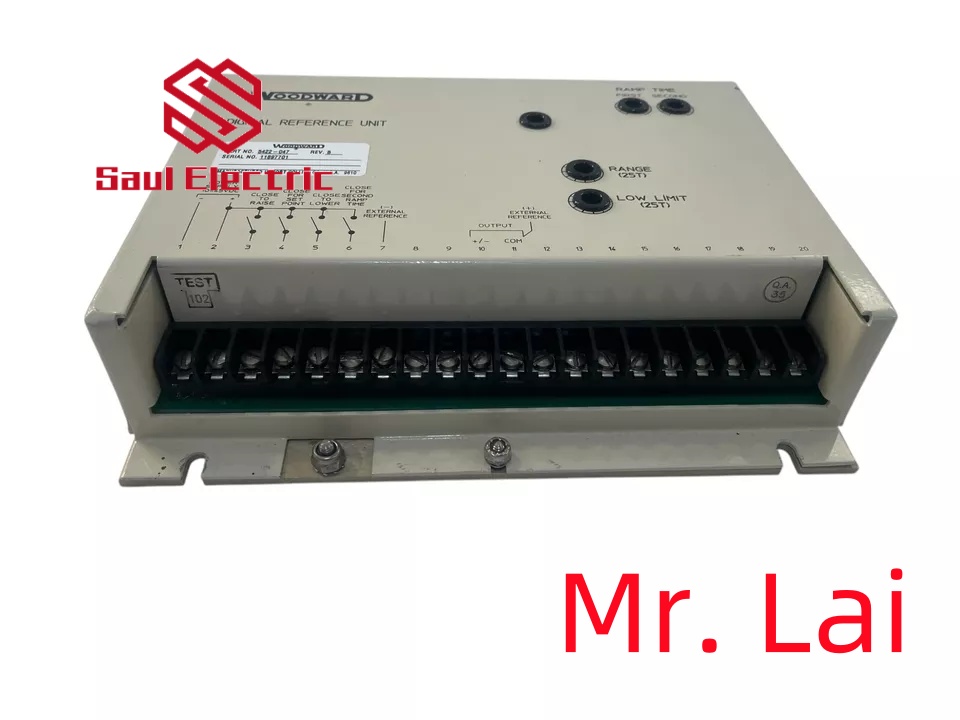
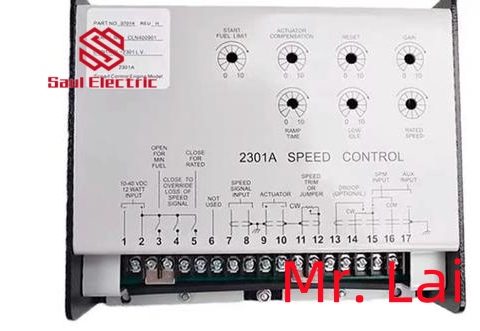
Woodward 8272-288 | Governor | Controller | Potential Converter
1.8272-288 Product Overview

The Woodward 8272-288 belongs to the 505/505E series digital turbine controllers. It is a microprocessor-based control module designed for single-valve steam turbines,
including single extraction/admission systems or split-range actuator configurations.
The controller features a front panel Operator Control Panel (OCP) with a two-line, 24-character display and multi-function keypad, allowing easy on-site configuration and monitoring.
2. 8272-288 Technical Specifications and Parameters
| Parameter | Details |
|---|---|
| Power Supply | +24 VDC, approx. 1 A |
| I/O Outputs | Discrete Outputs: 8 Analog Outputs: 6 Actuator Outputs: 2 |
| Display / HMI | Two-line, 24-character LCD, with multi-function keypad |
| Dimensions | Approx. 14 × 11 × 4 in (35.6 × 27.9 × 10.2 cm) |
| Weight | Approx. 9.11 lbs (4.13 kg) |
| Operating Temperature | –4 to +140 °F (–20 to +60 °C) |
| Storage Temperature | –40 to +185 °F (–40 to +85 °C) |
| Humidity Standard | 95% RH at 20-55 °C for 48 hours without damage |
| Protection Class | Typically meets industrial dust and water protection standards |
| Communication Protocol | Supports Modbus, RS-232 / RS-422 serial interfaces |

3. Brand History
Woodward, Inc., founded in 1870 and headquartered in Fort Collins, Colorado, USA, is a global leader in energy control systems. The company has a long history of innovation in turbine control, engine management,
and power generation systems.
Woodward products are widely recognized for their reliability and precision in demanding industrial and power generation applications.
4. Applications in Industrial Automation
The 8272-288 plays a critical role in industrial automation and power generation environments:
- Steam Turbine Control: Manages startup, speed regulation, and extraction/admission control of steam turbines.
- Power Generation Systems: Used in power plants to regulate turbine-driven generators for stable frequency and load management.
- Compressor and Pump Drive Control: Ensures precise speed control for turbine-driven compressors and pumps.
- Process Industry Applications: Applied in chemical plants, refineries, and other industries requiring precise turbine operation.
- Safety and Protection Functions: Includes overspeed protection, critical speed avoidance, actuator travel limits, and event logging for operational safety.

Global Domain Controller Market Forecast
The entire automotive industry generally believes that domain controllers are the most competitive and profitable part of
the automotive electronics industry in the future, benefiting chip manufacturers and core algorithm suppliers.
(1) The driving factors behind the rapid growth of the domain controller market
More and better ADAS functions and intelligent cockpit and information entertainment functions have always been the main factors
driving the rapid growth of the domain controller market. These new functions can significantly improve the technological sense and use
r experience of the entire vehicle, and therefore are also the focus of investment for OEMs when developing new models. ADAS applications
between L1 and L2+levels have developed rapidly in recent years, with many functions rapidly becoming popular, such as parking assistance,
lane departure warning, adaptive cruise control, collision avoidance, blind spot detection, driver fatigue detection, etc.
A domain controller requires a more powerful and integrated main control processor as its brain. More functions that were originally implemented through
separate ECUs can now be implemented on the domain main control processor, which can save more ECU usage and other hardware resources required
in the functional domain. Higher integration can meet the requirements of ADAS domain control and related component platformization and standardization in the supply chain management of host factories.
(2) The impact on the supply chain of domain controllers
The evolution and development of automotive E/E architecture have also profoundly influenced the supply relationship between OEMs and automotive electronics suppliers.
The core competitiveness of the host factory has shifted from mainly mechanical manufacturing to focusing on software and algorithms.
It is expected that there may be two cooperation models between vehicle manufacturers and Tier 1 suppliers in the future:
Firstly, Tier 1 is responsible for the hardware design and production of domain controllers, as well as the middleware software part of the intermediate layer.
The vehicle manufacturer is responsible for the autonomous driving software part. The advantage of Tier 1 is to produce products at a
reasonable cost and accelerate their implementation. Therefore, it is inevitable for vehicle manufacturers to cooperate with Tier 1 in production.
The former is responsible for the autonomous driving software part, while the latter is responsible for hardware production, intermediate layer,
and chip solution integration. In this mode, when the project is approved, the vehicle manufacturer may cross Tier 1 and directly determine the chip selection of the solution with the chip manufacturer.
Secondly, Tier 1 collaborates with chip manufacturers to develop central domain controllers after integrating solutions and sell
them to vehicle manufacturers, such as Continental ADCU, ZF ProAI, Magna MAX4, etc.


There are no reviews yet.