

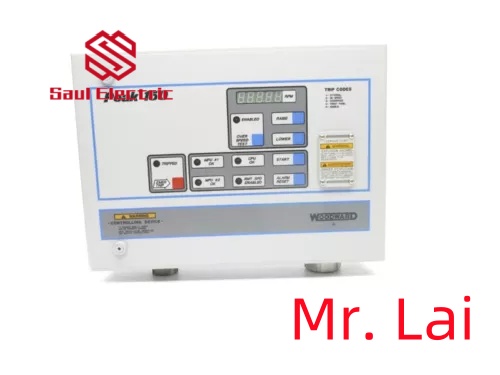
Woodward 8273-584 505 Turbine Control | 100% Original
1.8273-584 Product Overview

The Woodward 8273-584 belongs to the 505/505E series digital turbine controllers. It is a microprocessor-based control module designed for single-valve steam turbines,
including single extraction/admission systems or split-range actuator configurations.
The controller features a front panel Operator Control Panel (OCP) with a two-line, 24-character display and multi-function keypad, allowing easy on-site configuration and monitoring.
2. 8273-584 Technical Specifications and Parameters
| Parameter | Details |
|---|---|
| Power Supply | +24 VDC, approx. 1 A |
| I/O Outputs | Discrete Outputs: 8 Analog Outputs: 6 Actuator Outputs: 2 |
| Display / HMI | Two-line, 24-character LCD, with multi-function keypad |
| Dimensions | Approx. 14 × 11 × 4 in (35.6 × 27.9 × 10.2 cm) |
| Weight | Approx. 9.11 lbs (4.13 kg) |
| Operating Temperature | –4 to +140 °F (–20 to +60 °C) |
| Storage Temperature | –40 to +185 °F (–40 to +85 °C) |
| Humidity Standard | 95% RH at 20-55 °C for 48 hours without damage |
| Protection Class | Typically meets industrial dust and water protection standards |
| Communication Protocol | Supports Modbus, RS-232 / RS-422 serial interfaces |

3. Brand History
Woodward, Inc., founded in 1870 and headquartered in Fort Collins, Colorado, USA, is a global leader in energy control systems. The company has a long history of innovation in turbine control, engine management,
and power generation systems.
Woodward products are widely recognized for their reliability and precision in demanding industrial and power generation applications.
4. Applications in Industrial Automation
The 8273-584 plays a critical role in industrial automation and power generation environments:
- Steam Turbine Control: Manages startup, speed regulation, and extraction/admission control of steam turbines.
- Power Generation Systems: Used in power plants to regulate turbine-driven generators for stable frequency and load management.
- Compressor and Pump Drive Control: Ensures precise speed control for turbine-driven compressors and pumps.
- Process Industry Applications: Applied in chemical plants, refineries, and other industries requiring precise turbine operation.
- Safety and Protection Functions: Includes overspeed protection, critical speed avoidance, actuator travel limits, and event logging for operational safety.

3. Control form of motion controller
Point motion control: It only requires the endpoint position and is independent of the intermediate process of motion, that is, the motion trajectory.
The corresponding motion controller requires fast positioning speed, and different acceleration and deceleration control strategies are adopted in
the acceleration and deceleration stages of the motion.
During acceleration, in order to quickly accelerate the system to the set speed, the system gain is often increased and the acceleration is increased.
In the final stage of deceleration, an S-shaped deceleration control strategy is adopted. In order to prevent vibration after the system is in place,
the gain of the system will be appropriately reduced after planning is in place. Therefore, point motion controllers often have the ability to adjust control
parameters and acceleration/deceleration curves online.
Continuous trajectory motion control: This control, also known as contour control, is mainly applied in the motion contour control of traditional CNC
systems and cutting systems. The corresponding problem that the motion controller needs to solve is how to ensure the contour accuracy of
the system during high-speed motion, while also ensuring a constant tangential velocity of the tool when moving along the contour. When processing
small line segments, there is a multi segment program preprocessing function.
Synchronous motion control: refers to the coordinated control of motion between multiple axes, which can be achieved by synchronizing multiple axes
throughout the entire motion or by locally synchronizing speed during the motion process. It is mainly used in system control that requires electronic gearbox
and electronic cam functions. There are industries such as printing and dyeing, printing, papermaking, steel rolling, and synchronous shearing in the industry.
The control algorithm of the corresponding motion controller often adopts adaptive feedforward control, which automatically adjusts the amplitude and phase of
the control variable to ensure that a control effect equal to the interference
amplitude and opposite in phase is added at the input end to suppress periodic interference and ensure synchronous control of the system.


There are no reviews yet.