

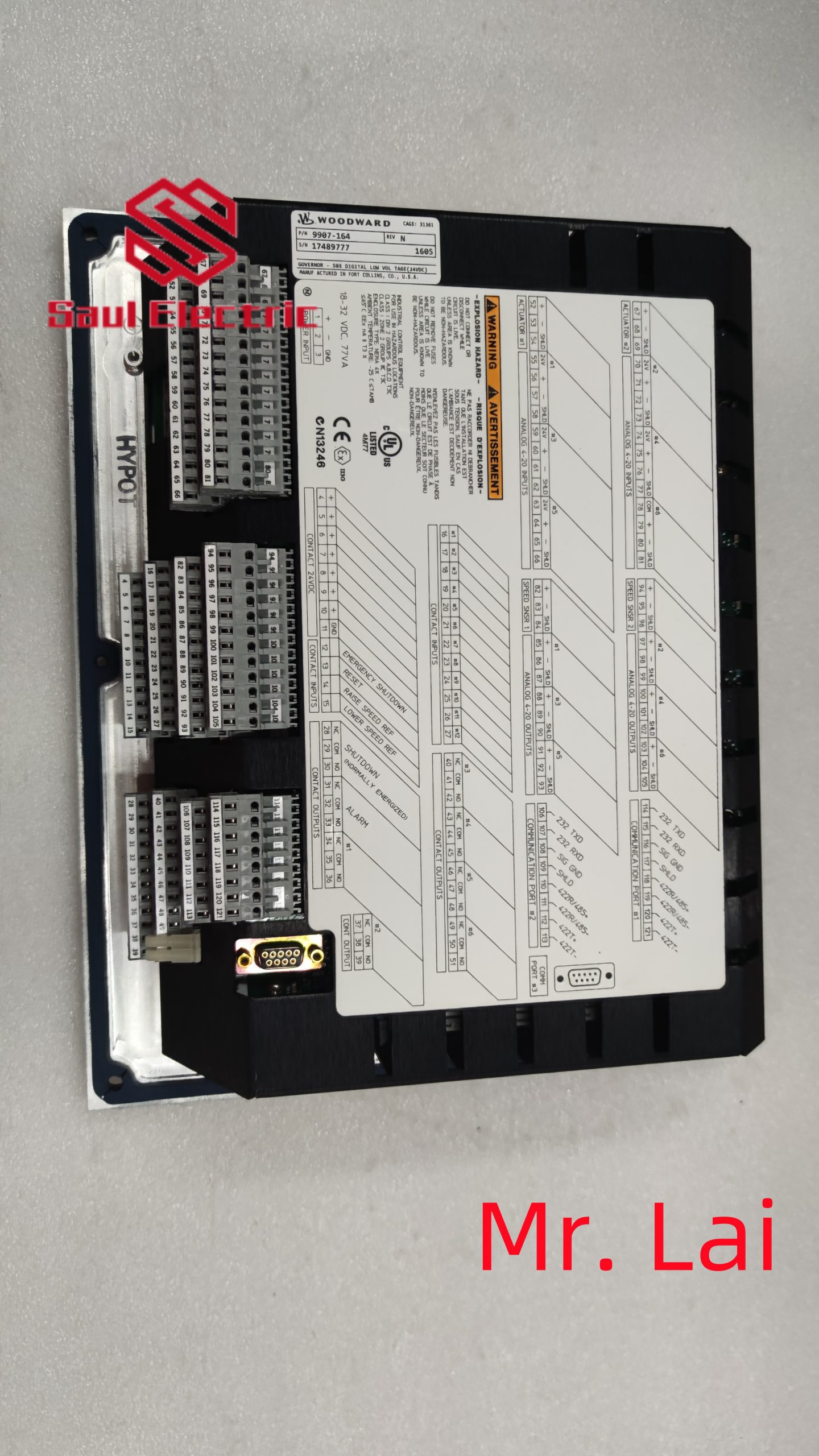
Woodward 8290-194 | Governor | Controller | Potential Converter
1.8290-194 Product Overview

The Woodward 8290-194 belongs to the 505/505E series digital turbine controllers. It is a microprocessor-based control module designed for single-valve steam turbines,
including single extraction/admission systems or split-range actuator configurations.
The controller features a front panel Operator Control Panel (OCP) with a two-line, 24-character display and multi-function keypad, allowing easy on-site configuration and monitoring.
2. 8290-194 Technical Specifications and Parameters
| Parameter | Details |
|---|---|
| Power Supply | +24 VDC, approx. 1 A |
| I/O Outputs | Discrete Outputs: 8 Analog Outputs: 6 Actuator Outputs: 2 |
| Display / HMI | Two-line, 24-character LCD, with multi-function keypad |
| Dimensions | Approx. 14 × 11 × 4 in (35.6 × 27.9 × 10.2 cm) |
| Weight | Approx. 9.11 lbs (4.13 kg) |
| Operating Temperature | –4 to +140 °F (–20 to +60 °C) |
| Storage Temperature | –40 to +185 °F (–40 to +85 °C) |
| Humidity Standard | 95% RH at 20-55 °C for 48 hours without damage |
| Protection Class | Typically meets industrial dust and water protection standards |
| Communication Protocol | Supports Modbus, RS-232 / RS-422 serial interfaces |

3. Brand History
Woodward, Inc., founded in 1870 and headquartered in Fort Collins, Colorado, USA, is a global leader in energy control systems. The company has a long history of innovation in turbine control, engine management,
and power generation systems.
Woodward products are widely recognized for their reliability and precision in demanding industrial and power generation applications.
4. Applications in Industrial Automation
The 8290-194 plays a critical role in industrial automation and power generation environments:
- Steam Turbine Control: Manages startup, speed regulation, and extraction/admission control of steam turbines.
- Power Generation Systems: Used in power plants to regulate turbine-driven generators for stable frequency and load management.
- Compressor and Pump Drive Control: Ensures precise speed control for turbine-driven compressors and pumps.
- Process Industry Applications: Applied in chemical plants, refineries, and other industries requiring precise turbine operation.
- Safety and Protection Functions: Includes overspeed protection, critical speed avoidance, actuator travel limits, and event logging for operational safety.

1. The fault phenomenon is that once started, the external fuse of the stepper drive burns out and the equipment cannot operate.
During the inspection, the maintenance personnel found that a power tube was damaged. However, due to a lack of information,
they could not understand the function of the tube and thought it was a power driven front push. They replaced it with a power tube
and after powering it on, the fuse was burned again, and the replaced tube was also damaged. After inspection by professional
maintenance personnel, the initial analysis was correct, that is, the fuse repeatedly melted, indicating that there must be some
abnormal high current in the stepper driver, and it was found that one power transistor was damaged. But the function of the tube
is not clear. In fact, this tube is a power drive tube for stepper motors, which start at high voltage and therefore have to withstand high
voltage and high current. Static inspection revealed that the resistance value from the power supply to the ground terminal in the
circuit of the pulse ring distributor is very small, but there is no short circuit. Based on the number of components in the circuit and their
power consumption analysis, the resistance value from the power supply to the ground should not be so small, so it is suspected that some
components in the circuit have been damaged.
2. During the power on inspection, it was found that one chip was abnormally heating up. After power failure, cut off the power pin of the chip,
perform static inspection, and it should be normal for the impedance from the power supply to ground to increase. The resistance value from
the power supply to ground of the chip is very small. Check the model of the chip, it is a non-standard model and cannot be found in many manuals.
After circuit analysis, it was confirmed that it is the main component in the board: the ring pulse distributor.
3. To further confirm the issue with the chip, first replace the power drive tube of the stepper motor with a voltage withstand current of equivalent power,
restore the power pin of the chip, and use a light-emitting diode circuit to replace the windings of the stepper motor as a simulated load.
After power on, all the light-emitting diodes are lit up, indicating that all windings are powered on. This does not meet the requirements of the circuit,
as there is no response to the input step pulse. Therefore, it is confirmed that the chip is damaged.
4. Solution: This chip is not available on the market. When the space inside the driver housing allows, a combination circuit was used to
design a circular pulse generator by combining the existing D flip-flop and NAND gate. The generator was fabricated on a small printed circuit board, and the original chip was removed and the small
printed circuit board was mounted on the solder pads of the original chip through pins. Still using light-emitting diodes as simulated loads,
after being powered on, apply step pulses to sequentially emit light in phase sequence.
Dismantle the simulated load, connect to the host, power on, and ensure that the equipment is running normally.
5. This example illustrates that maintenance personnel not only need to be able to analyze phenomena (overcurrent) and identify
obvious causes (power tube damage), but also need to be able to analyze the initial cause of the fault step by step (pulse generator damage),
and be able to use existing component combinations at hand to replace difficult to solve device problems.




There are no reviews yet.