

Woodward 8400-061 from SAUL ELECTRIC | In Stock
1.8400-061 Product Overview

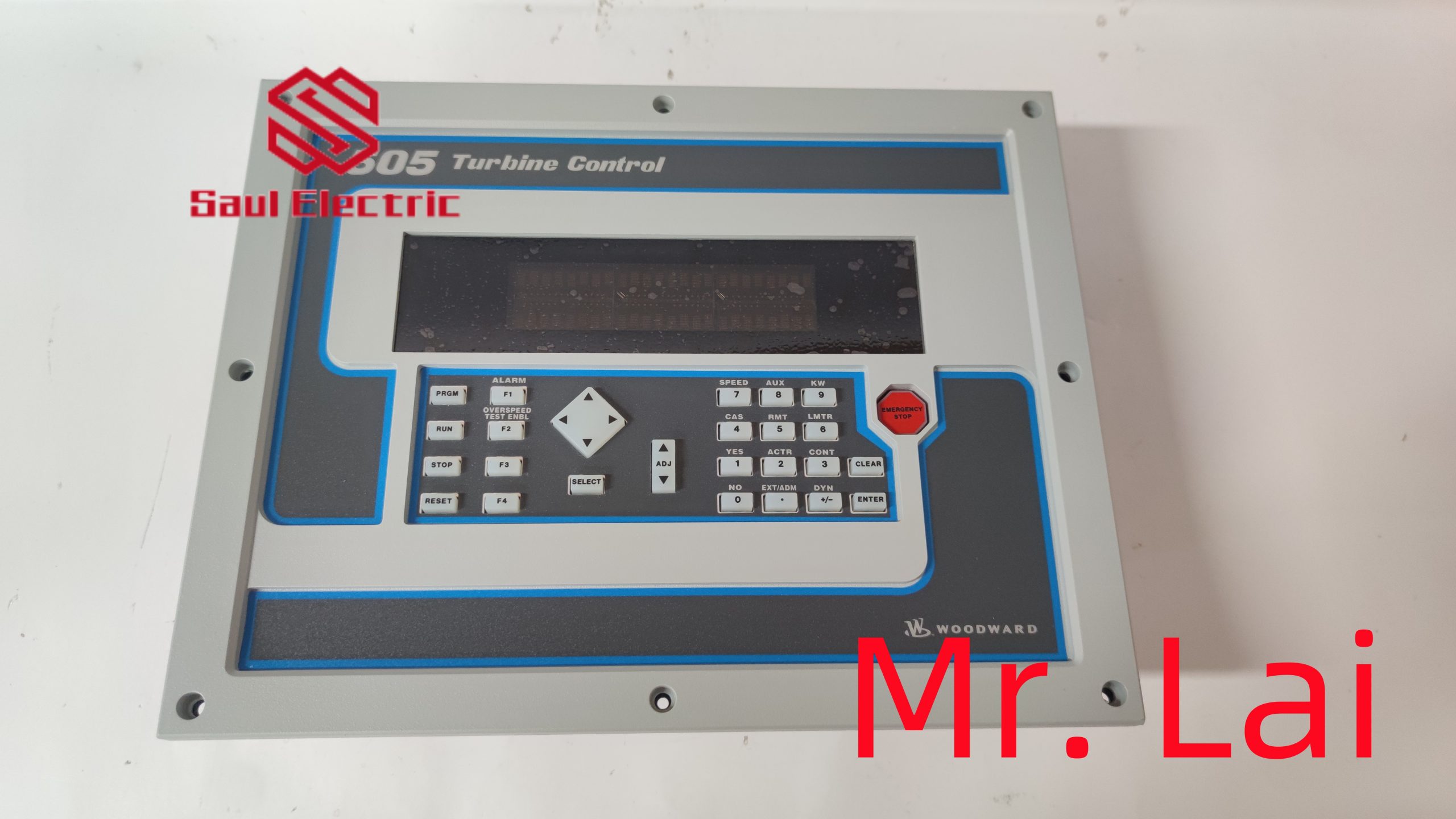
The Woodward 8400-061 belongs to the 505/505E series digital turbine controllers. It is a microprocessor-based control module designed for single-valve steam turbines,
including single extraction/admission systems or split-range actuator configurations.
The controller features a front panel Operator Control Panel (OCP) with a two-line, 24-character display and multi-function keypad, allowing easy on-site configuration and monitoring.
2. 8400-061 Technical Specifications and Parameters
| Parameter | Details |
|---|---|
| Power Supply | +24 VDC, approx. 1 A |
| I/O Outputs | Discrete Outputs: 8 Analog Outputs: 6 Actuator Outputs: 2 |
| Display / HMI | Two-line, 24-character LCD, with multi-function keypad |
| Dimensions | Approx. 14 × 11 × 4 in (35.6 × 27.9 × 10.2 cm) |
| Weight | Approx. 9.11 lbs (4.13 kg) |
| Operating Temperature | –4 to +140 °F (–20 to +60 °C) |
| Storage Temperature | –40 to +185 °F (–40 to +85 °C) |
| Humidity Standard | 95% RH at 20-55 °C for 48 hours without damage |
| Protection Class | Typically meets industrial dust and water protection standards |
| Communication Protocol | Supports Modbus, RS-232 / RS-422 serial interfaces |

3. Brand History
Woodward, Inc., founded in 1870 and headquartered in Fort Collins, Colorado, USA, is a global leader in energy control systems. The company has a long history of innovation in turbine control, engine management,
and power generation systems.
Woodward products are widely recognized for their reliability and precision in demanding industrial and power generation applications.
4. Applications in Industrial Automation
The 8400-061 plays a critical role in industrial automation and power generation environments:
- Steam Turbine Control: Manages startup, speed regulation, and extraction/admission control of steam turbines.
- Power Generation Systems: Used in power plants to regulate turbine-driven generators for stable frequency and load management.
- Compressor and Pump Drive Control: Ensures precise speed control for turbine-driven compressors and pumps.
- Process Industry Applications: Applied in chemical plants, refineries, and other industries requiring precise turbine operation.
- Safety and Protection Functions: Includes overspeed protection, critical speed avoidance, actuator travel limits, and event logging for operational safety.

Analysis of Typical Feedback Controller and PID Controller Algorithm Principles
Algorithm Principles
The PID controller, also known as a proportional, integral, or differential controller, takes error as input and calculates the
output by weighting the sum of proportional, integral, and differential terms. The PID controller is a very classic controller that
is simple and easy to understand, and can be used without the need for an accurate system model. It has a wide range of applications.
There are many introduction materials about PID online, and there are also many easy to understand explanations.
When I introduce the principles of algorithms here, in addition to qualitative analysis, it will also involve some theoretical knowledge,
which requires a certain level of professional knowledge in “Automatic Control Principles” and “Signals and Systems”. However,
it will not be too in-depth, and they are all simple entry-level knowledge.
Let”s first explain why closed-loop control is necessary, taking controlling the speed of a motor as an example. Before actual control,
we may assume that as long as I
give the motor an expected speed of 100 revolutions per minute, it will obediently output the result of 100 revolutions per minute.
But what about the actual situation? When the motor is unloaded, it may still be able to reach the desired speed, but what if a 10 pound
load is added to the motor? Its speed may drop to 80 revolutions per minute, and if the load continues to increase, the speed may continue to decrease.



There are no reviews yet.