

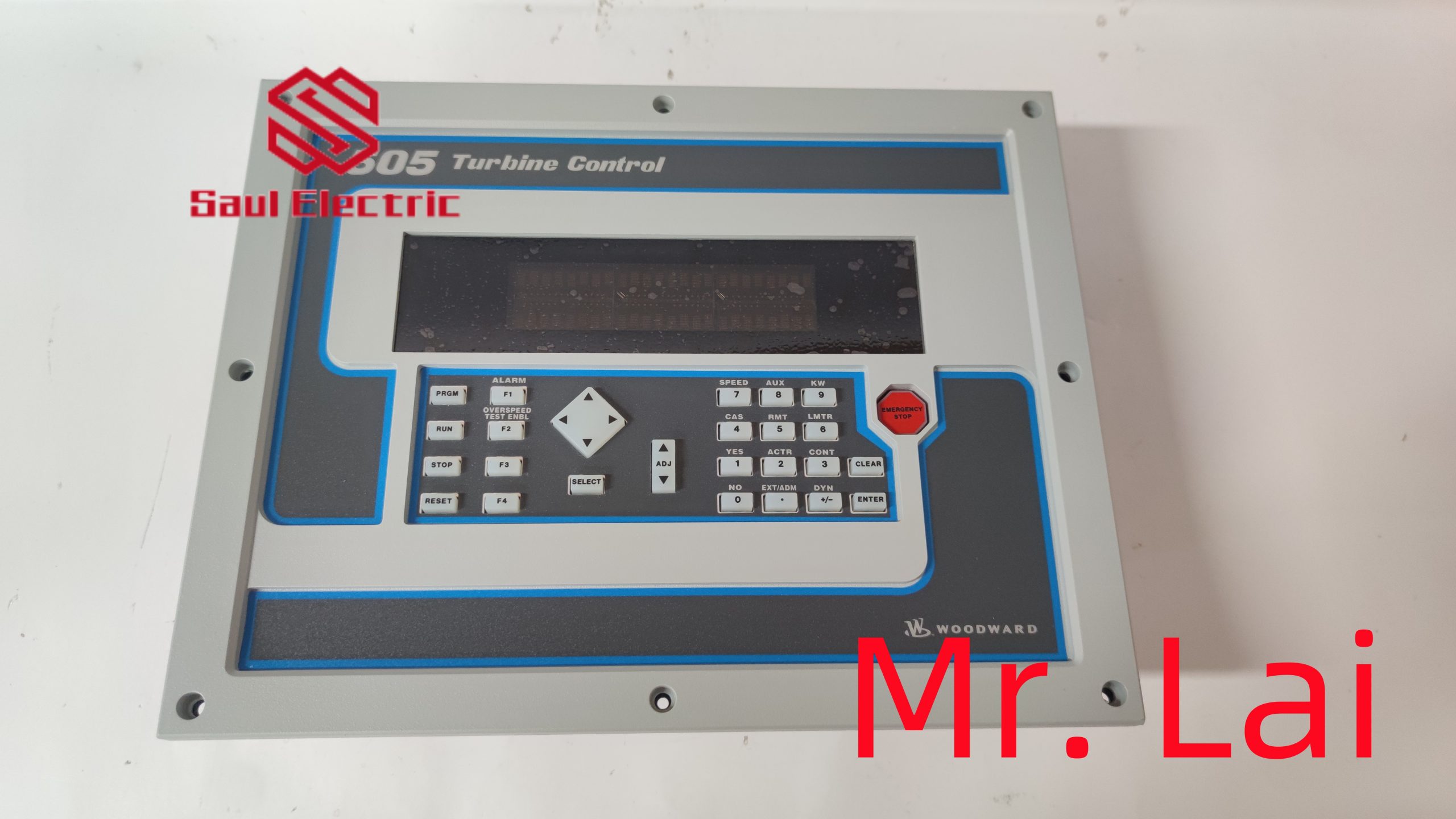
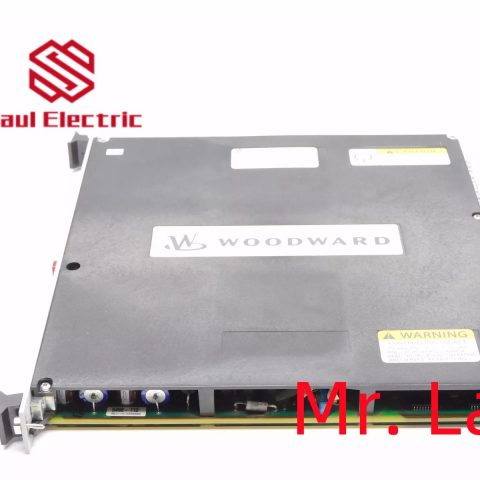
Woodward 8404-030 505 Turbine Control | 100% Original
1.8404-030 Product Overview

The Woodward 8404-030 belongs to the 505/505E series digital turbine controllers. It is a microprocessor-based control module designed for single-valve steam turbines,
including single extraction/admission systems or split-range actuator configurations.
The controller features a front panel Operator Control Panel (OCP) with a two-line, 24-character display and multi-function keypad, allowing easy on-site configuration and monitoring.
2. 8404-030 Technical Specifications and Parameters
| Parameter | Details |
|---|---|
| Power Supply | +24 VDC, approx. 1 A |
| I/O Outputs | Discrete Outputs: 8 Analog Outputs: 6 Actuator Outputs: 2 |
| Display / HMI | Two-line, 24-character LCD, with multi-function keypad |
| Dimensions | Approx. 14 × 11 × 4 in (35.6 × 27.9 × 10.2 cm) |
| Weight | Approx. 9.11 lbs (4.13 kg) |
| Operating Temperature | –4 to +140 °F (–20 to +60 °C) |
| Storage Temperature | –40 to +185 °F (–40 to +85 °C) |
| Humidity Standard | 95% RH at 20-55 °C for 48 hours without damage |
| Protection Class | Typically meets industrial dust and water protection standards |
| Communication Protocol | Supports Modbus, RS-232 / RS-422 serial interfaces |

3. Brand History
Woodward, Inc., founded in 1870 and headquartered in Fort Collins, Colorado, USA, is a global leader in energy control systems. The company has a long history of innovation in turbine control, engine management,
and power generation systems.
Woodward products are widely recognized for their reliability and precision in demanding industrial and power generation applications.
4. Applications in Industrial Automation
The 8404-030 plays a critical role in industrial automation and power generation environments:
- Steam Turbine Control: Manages startup, speed regulation, and extraction/admission control of steam turbines.
- Power Generation Systems: Used in power plants to regulate turbine-driven generators for stable frequency and load management.
- Compressor and Pump Drive Control: Ensures precise speed control for turbine-driven compressors and pumps.
- Process Industry Applications: Applied in chemical plants, refineries, and other industries requiring precise turbine operation.
- Safety and Protection Functions: Includes overspeed protection, critical speed avoidance, actuator travel limits, and event logging for operational safety.

Step 2: Check the software architecture
The software architecture and requirements have a significant impact on the selection of microcontrollers. The severity of the processing requirements
determines whether to use an 80 MHz DSP or an 8 MHz 8051. Like hardware, all important requirements should be noted down.
Step 3: Select Architecture
Using the information from steps 1 and 2, engineers should be able to have a preliminary idea of the required architecture.
Can the application be implemented through an 8-bit architecture? Where are the 16? Do you still need a 32-bit ARM core?
These issues will begin to converge into a solution between the application and the required software algorithms. Don”t forget
about possible future requirements and functional extensions.
Just because 8-bit microcontrollers can meet your current requirements, you cannot disregard 16 bit microcontrollers for future
functionality or ease of use. Please remember that microcontroller selection can be an iterative process.
You may choose a 16 bit period in this step, but later find that 32-bit ARM components are more suitable. This step only allows
engineers to determine the correct direction of progress.
Step 4: Determine Memory Requirements
For any microcontroller, flash memory and RAM are two very important components. Ensuring that there is no shortage of program
space, or variable space, is definitely the top priority. When selecting components, it is easy to choose components with excessive
functionality rather than those with insufficient functionality.
At the end of the design, it is not uncommon to find that 110% of the space is needed or some features need to be reduced. After
all, you always start by wanting more and then move on to limiting slightly more components within the same chip family.
By utilizing the software architecture and communication peripherals included in the application, engineers can estimate the required
flash and RAM sizes for the application. Remember to leave some space for feature extensions and future versions! This can save a lot of trouble for the future.


There are no reviews yet.