

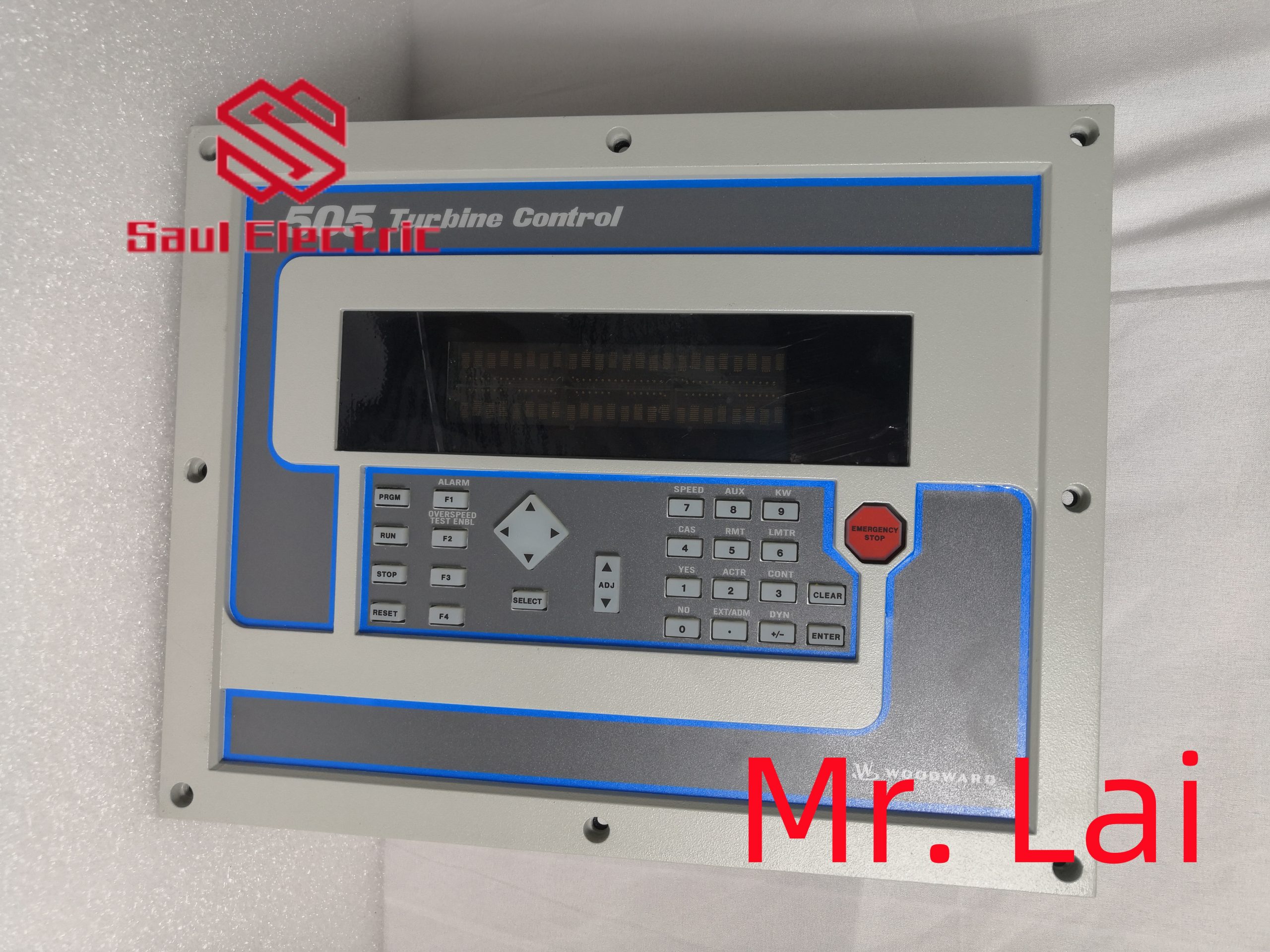
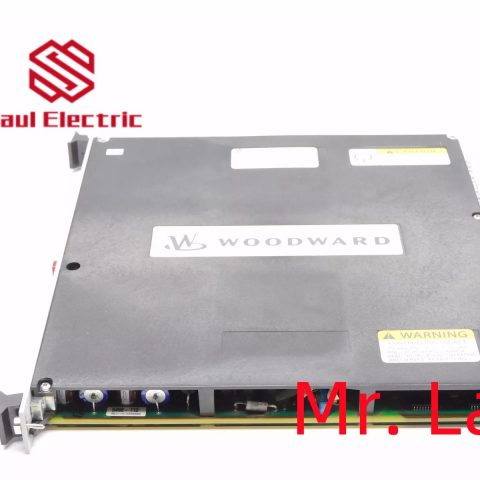
Woodward 8406-102 Price Discount | In Stock
1.8406-102 Product Overview

The Woodward 8406-102 belongs to the 505/505E series digital turbine controllers. It is a microprocessor-based control module designed for single-valve steam turbines,
including single extraction/admission systems or split-range actuator configurations.
The controller features a front panel Operator Control Panel (OCP) with a two-line, 24-character display and multi-function keypad, allowing easy on-site configuration and monitoring.
2. 8406-102 Technical Specifications and Parameters
| Parameter | Details |
|---|---|
| Power Supply | +24 VDC, approx. 1 A |
| I/O Outputs | Discrete Outputs: 8 Analog Outputs: 6 Actuator Outputs: 2 |
| Display / HMI | Two-line, 24-character LCD, with multi-function keypad |
| Dimensions | Approx. 14 × 11 × 4 in (35.6 × 27.9 × 10.2 cm) |
| Weight | Approx. 9.11 lbs (4.13 kg) |
| Operating Temperature | –4 to +140 °F (–20 to +60 °C) |
| Storage Temperature | –40 to +185 °F (–40 to +85 °C) |
| Humidity Standard | 95% RH at 20-55 °C for 48 hours without damage |
| Protection Class | Typically meets industrial dust and water protection standards |
| Communication Protocol | Supports Modbus, RS-232 / RS-422 serial interfaces |

3. Brand History
Woodward, Inc., founded in 1870 and headquartered in Fort Collins, Colorado, USA, is a global leader in energy control systems. The company has a long history of innovation in turbine control, engine management,
and power generation systems.
Woodward products are widely recognized for their reliability and precision in demanding industrial and power generation applications.
4. Applications in Industrial Automation
The 8406-102 plays a critical role in industrial automation and power generation environments:
- Steam Turbine Control: Manages startup, speed regulation, and extraction/admission control of steam turbines.
- Power Generation Systems: Used in power plants to regulate turbine-driven generators for stable frequency and load management.
- Compressor and Pump Drive Control: Ensures precise speed control for turbine-driven compressors and pumps.
- Process Industry Applications: Applied in chemical plants, refineries, and other industries requiring precise turbine operation.
- Safety and Protection Functions: Includes overspeed protection, critical speed avoidance, actuator travel limits, and event logging for operational safety.

3. Bipolar drive
The driving circuit of a bipolar stepper motor is shown in Figure 2, which uses eight transistors to drive two sets of phases. Bipolar drive circuits
can simultaneously drive four wire or six wire stepper motors. Although four wire motors can only use bipolar drive circuits, they can significantly
reduce the cost of mass-produced applications. The number of transistors in the bipolar stepper motor drive circuit is twice that of the unipolar
drive circuit. The four lower
transistors are usually directly driven by a microcontroller, while the upper transistors require a higher cost upper drive circuit. The transistor of a
bipolar drive circuit only needs to withstand the motor voltage, so it does not require a clamping circuit like a unipolar drive circuit.
Stepper Driver Principle Stepper Motor Driver Selection
4. Microstep driver
Stepper Driver Principle Stepper Motor Driver Selection
Microstep driving technology is a current waveform control technology. The basic idea is to control the waveform of the current in each phase winding,
so that it rises or falls in steps, that is, to provide multiple stable intermediate states between 0 and the maximum value. During the rotation
of the stator magnetic field, there are also multiple stable intermediate states, corresponding to an increase in the number of steps and
a decrease in the step angle of the motor rotor rotation. The use of subdivision drive technology can greatly improve the step torque resolution
of stepper motors, reduce torque fluctuations, avoid low-frequency resonance, and reduce operating noise.


There are no reviews yet.