

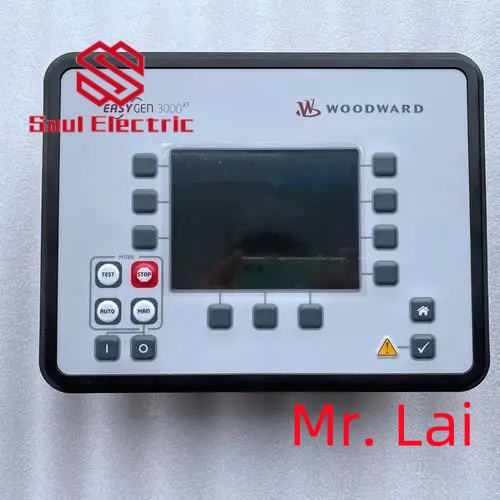
Woodward 8406-116 | Governor | Controller | Potential Converter
1.8406-116 Product Overview

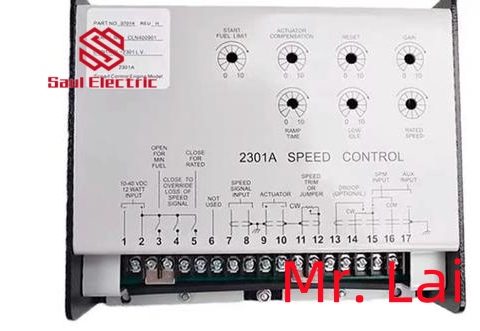
The Woodward 8406-116 belongs to the 505/505E series digital turbine controllers. It is a microprocessor-based control module designed for single-valve steam turbines,
including single extraction/admission systems or split-range actuator configurations.
The controller features a front panel Operator Control Panel (OCP) with a two-line, 24-character display and multi-function keypad, allowing easy on-site configuration and monitoring.
2. 8406-116 Technical Specifications and Parameters
| Parameter | Details |
|---|---|
| Power Supply | +24 VDC, approx. 1 A |
| I/O Outputs | Discrete Outputs: 8 Analog Outputs: 6 Actuator Outputs: 2 |
| Display / HMI | Two-line, 24-character LCD, with multi-function keypad |
| Dimensions | Approx. 14 × 11 × 4 in (35.6 × 27.9 × 10.2 cm) |
| Weight | Approx. 9.11 lbs (4.13 kg) |
| Operating Temperature | –4 to +140 °F (–20 to +60 °C) |
| Storage Temperature | –40 to +185 °F (–40 to +85 °C) |
| Humidity Standard | 95% RH at 20-55 °C for 48 hours without damage |
| Protection Class | Typically meets industrial dust and water protection standards |
| Communication Protocol | Supports Modbus, RS-232 / RS-422 serial interfaces |

3. Brand History
Woodward, Inc., founded in 1870 and headquartered in Fort Collins, Colorado, USA, is a global leader in energy control systems. The company has a long history of innovation in turbine control, engine management,
and power generation systems.
Woodward products are widely recognized for their reliability and precision in demanding industrial and power generation applications.
4. Applications in Industrial Automation
The 8406-116 plays a critical role in industrial automation and power generation environments:
- Steam Turbine Control: Manages startup, speed regulation, and extraction/admission control of steam turbines.
- Power Generation Systems: Used in power plants to regulate turbine-driven generators for stable frequency and load management.
- Compressor and Pump Drive Control: Ensures precise speed control for turbine-driven compressors and pumps.
- Process Industry Applications: Applied in chemical plants, refineries, and other industries requiring precise turbine operation.
- Safety and Protection Functions: Includes overspeed protection, critical speed avoidance, actuator travel limits, and event logging for operational safety.

For example, the microcontroller that controls a car engine must be able to operate at temperature limits that general computers cannot withstand.
The microcontroller of a car in Alaska, USA needs to operate in cold weather of minus 34 degrees Celsius, while the same controller in Nevada,
USA needs to operate in a hot environment of above 49 degrees Celsius. Combined with the heat generated by the engine operation, the temperature of the
engine case can reach as high as 65-80 degrees Celsius above zero.
The embedded microcontroller used inside the video recorder does not have such strict requirements.
In fact, there are various types of processors used as microcontrollers. For example, the mobile phone mentioned in the article “Working Principles
of Digital Mobile Phones” contains a Z-80 processor. The Z-80 processor is an 8-bit microprocessor that was born in the 1970s and was initially used in
home computers at that time. The Garmin global positioning system in the working principle of GPS receivers includes a low-power version of Intel 80386 processor,
which is said to be like this. The Intel 80386 processor was originally designed specifically for desktop computers.
In many products, such as microwave ovens, the requirements for microcontroller performance are very low, and price is the main consideration factor. In this situation,
manufacturers began designing dedicated microcontroller chips – an embedded central processing unit designed specifically for low cost, small size, and low power
consumption. Motorola 6811 and Intel 8051 are both successful examples of this type of chip. In addition, there is a series of controllers called “PIC microcontrollers”
produced by Microchip, which are also very popular. By today”s standards, these central processing units are unbelievably simple; But the price for bulk purchases is very low,
and often only one piece is needed to meet the needs of product designers.
A typical low-end microcontroller chip has approximately 1000 bytes of read-only memory and 20 bytes of random access memory, with 8 input/output pins. Mass production of this chip
costs only a few cents per unit. Of course, you can”t expect to run programs
like Microsoft Word on this chip – because Microsoft Word requires about 30 megabytes of random access storage space and a processor that can execute millions of instructions per
second. However, controlling a microwave oven does not require a complex program like Microsoft Word. What you need to accomplish with a microcontroller is a specific task, and low-cost, low-power operation is the most important.


There are no reviews yet.