

Woodward 8440-1019 Price Discount | In Stock
1.8440-1019 Product Overview

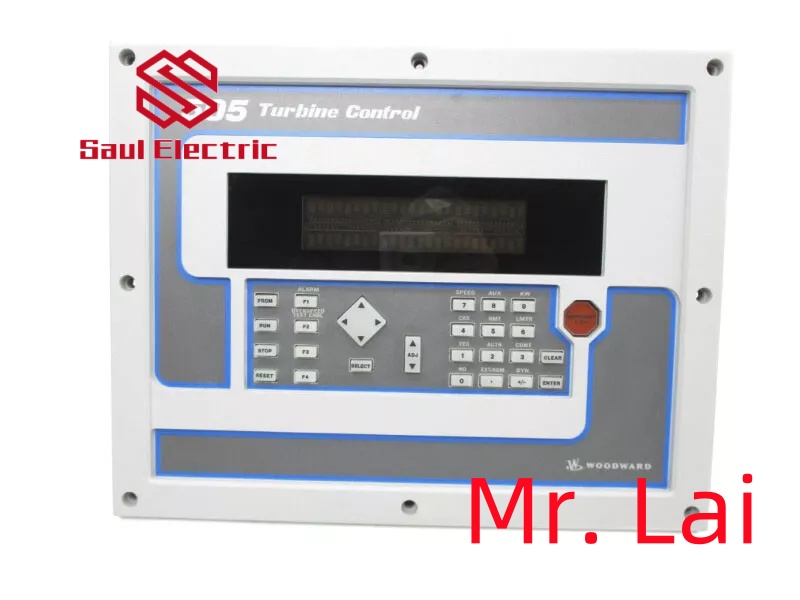
The Woodward 8440-1019 belongs to the 505/505E series digital turbine controllers. It is a microprocessor-based control module designed for single-valve steam turbines,
including single extraction/admission systems or split-range actuator configurations.
The controller features a front panel Operator Control Panel (OCP) with a two-line, 24-character display and multi-function keypad, allowing easy on-site configuration and monitoring.
2. 8440-1019 Technical Specifications and Parameters
| Parameter | Details |
|---|---|
| Power Supply | +24 VDC, approx. 1 A |
| I/O Outputs | Discrete Outputs: 8 Analog Outputs: 6 Actuator Outputs: 2 |
| Display / HMI | Two-line, 24-character LCD, with multi-function keypad |
| Dimensions | Approx. 14 × 11 × 4 in (35.6 × 27.9 × 10.2 cm) |
| Weight | Approx. 9.11 lbs (4.13 kg) |
| Operating Temperature | –4 to +140 °F (–20 to +60 °C) |
| Storage Temperature | –40 to +185 °F (–40 to +85 °C) |
| Humidity Standard | 95% RH at 20-55 °C for 48 hours without damage |
| Protection Class | Typically meets industrial dust and water protection standards |
| Communication Protocol | Supports Modbus, RS-232 / RS-422 serial interfaces |

3. Brand History
Woodward, Inc., founded in 1870 and headquartered in Fort Collins, Colorado, USA, is a global leader in energy control systems. The company has a long history of innovation in turbine control, engine management,
and power generation systems.
Woodward products are widely recognized for their reliability and precision in demanding industrial and power generation applications.
4. Applications in Industrial Automation
The 8440-1019 plays a critical role in industrial automation and power generation environments:
- Steam Turbine Control: Manages startup, speed regulation, and extraction/admission control of steam turbines.
- Power Generation Systems: Used in power plants to regulate turbine-driven generators for stable frequency and load management.
- Compressor and Pump Drive Control: Ensures precise speed control for turbine-driven compressors and pumps.
- Process Industry Applications: Applied in chemical plants, refineries, and other industries requiring precise turbine operation.
- Safety and Protection Functions: Includes overspeed protection, critical speed avoidance, actuator travel limits, and event logging for operational safety.

Basic requirements
Requirements for servo feed system
1. Wide speed range
2. High positioning accuracy
3. Having sufficient transmission rigidity and high speed stability
4. Quick response, no overshoot
In order to ensure productivity and processing quality, in addition to high positioning accuracy, it is also required to
have good fast response characteristics, that is, the response of tracking command signals should be fast, because the
CNC system requires sufficient acceleration and deceleration during startup and braking, shortening the transition process
time of the feeding system and reducing contour transition errors.
5. Low speed high torque, strong overload capacity
Generally speaking, servo drives have an overload capacity of 1.5 times or more within minutes or even half an hour,
and can be overloaded by 4 to 6 times in a short period of time without damage.
6. High reliability
The feed drive system of CNC machine tools is required to have high reliability, good working stability, strong
environmental adaptability to temperature, humidity, vibration, and strong anti-interference ability.
Requirements for motors
1. The motor can operate smoothly from the lowest speed to the highest speed, with minimal torque fluctuations,
especially at low speeds such as 0.1r/min or lower, where there is still a smooth speed without crawling phenomenon.
2. The motor should have a large and long-lasting overload capacity to meet the requirements of low-speed and high
torque. Generally, DC servo motors require an overload of 4-6 times within a few minutes without damage.
3. In order to meet the requirements of rapid response, the motor should have a small moment of inertia and a large
locked rotor torque, and have the smallest possible time constant and starting voltage.
4. The motor should be able to withstand frequent starting, braking, and reversing.



There are no reviews yet.