

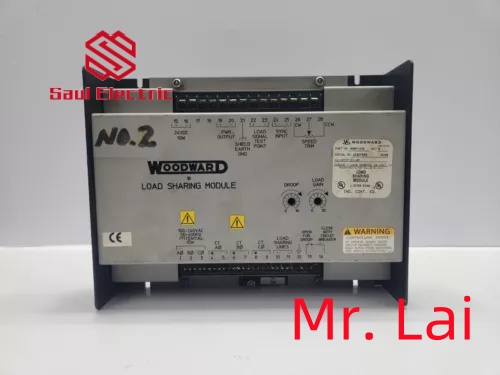
Woodward 8440-2028 | Governor | Controller | Potential Converter
1.8440-2028 Product Overview

The Woodward 8440-2028 belongs to the 505/505E series digital turbine controllers. It is a microprocessor-based control module designed for single-valve steam turbines,
including single extraction/admission systems or split-range actuator configurations.
The controller features a front panel Operator Control Panel (OCP) with a two-line, 24-character display and multi-function keypad, allowing easy on-site configuration and monitoring.
2. 8440-2028 Technical Specifications and Parameters
| Parameter | Details |
|---|---|
| Power Supply | +24 VDC, approx. 1 A |
| I/O Outputs | Discrete Outputs: 8 Analog Outputs: 6 Actuator Outputs: 2 |
| Display / HMI | Two-line, 24-character LCD, with multi-function keypad |
| Dimensions | Approx. 14 × 11 × 4 in (35.6 × 27.9 × 10.2 cm) |
| Weight | Approx. 9.11 lbs (4.13 kg) |
| Operating Temperature | –4 to +140 °F (–20 to +60 °C) |
| Storage Temperature | –40 to +185 °F (–40 to +85 °C) |
| Humidity Standard | 95% RH at 20-55 °C for 48 hours without damage |
| Protection Class | Typically meets industrial dust and water protection standards |
| Communication Protocol | Supports Modbus, RS-232 / RS-422 serial interfaces |

3. Brand History
Woodward, Inc., founded in 1870 and headquartered in Fort Collins, Colorado, USA, is a global leader in energy control systems. The company has a long history of innovation in turbine control, engine management,
and power generation systems.
Woodward products are widely recognized for their reliability and precision in demanding industrial and power generation applications.
4. Applications in Industrial Automation
The 8440-2028 plays a critical role in industrial automation and power generation environments:
- Steam Turbine Control: Manages startup, speed regulation, and extraction/admission control of steam turbines.
- Power Generation Systems: Used in power plants to regulate turbine-driven generators for stable frequency and load management.
- Compressor and Pump Drive Control: Ensures precise speed control for turbine-driven compressors and pumps.
- Process Industry Applications: Applied in chemical plants, refineries, and other industries requiring precise turbine operation.
- Safety and Protection Functions: Includes overspeed protection, critical speed avoidance, actuator travel limits, and event logging for operational safety.

receiver:
The receiver can adopt a larger number of digital integrated circuits. Of course, the closer the digital circuit of the receiver is to the antenna,
the more it can leverage the advantages of reception. Therefore, some people believe that an analog-to-digital converter can be
placed at the output of the RF system for direct RF sampling. This design may seem desirable, but it raises another issue that we have to consider.
In order to suppress unwanted out of band signals in advance and meet the frequency range required by the analog-to-digital converter,
the received signal must be filtered and undergo automatic gain control before being input into the analog-to-digital converter. Therefore,
many digital receivers adopt a compromise approach, first converting the analog signal into a digital signal through the first and second frequency stages
at the output end, so that the out of band signal is filtered before entering the analog-to-digital converter, and also ensuring that some signals are automatically
gain controlled in the analog stage before entering the analog-to-digital converter, in order to avoid the in band signal from driving the analog-to-digital converter as much as possible,
so that the signal can reach the maximum signal gain before undergoing analog-to-digital conversion. In addition, if we adopt intermediate frequency sampling
and digital reception technology, there is no need to add additional intermediate
frequency stages such as mixers, filters, and amplifiers, which helps reduce costs. Moreover, if system design engineers use programmable digital filters
instead of fixed analog filters, they can fully utilize the flexibility in design.
Device:
Texas Instruments (TI) recently announced the launch of a 4A high-speed synchronous driver TPS28225 for N-channel complementary drive power MOSFETs.
This 2MHz driver simplifies power supply design for high current single-phase and multi-phase applications, such as voltage regulator module (VRM) design, laptops,
isolated power supplies with secondary synchronous rectifiers, and DC/DC converters that require high efficiency.
TI”s TPS28225 driver controls the MOSFET gate with a voltage range of 4.5V to 8.8V, achieving high efficiency and low electromagnetic interference (EMI).
The device efficiency reaches its maximum when the current per phase exceeds 40A in the voltage range of 7V to 8V. TPS28225 has implemented 14ns adaptive dead time control,
14ns transmission delay time, 2A high current power supply, and 4A suction drive function. Other features of the driver include low impedance suction (typical value of 0.4 ohms)
and source current (typical value of 1 ohm) functionality; Acceptable a wide range of voltage input signals (3V to 24V range); Single pin supports Space saving (input) and
PowerGood (output) signals; The unique input level is compatible with all industry standard analog and digital controllers; Provide intelligent management functions for narrow duty cycle signals.



There are no reviews yet.