

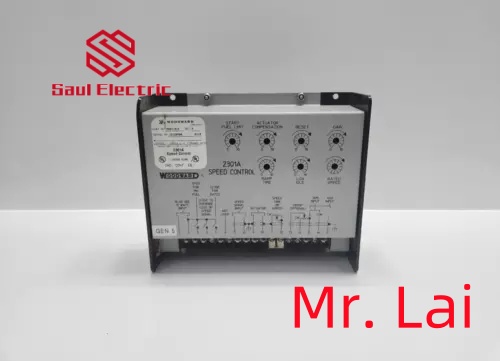
Woodward 8915-005 Price Discount | In Stock
1.8915-005 Product Overview

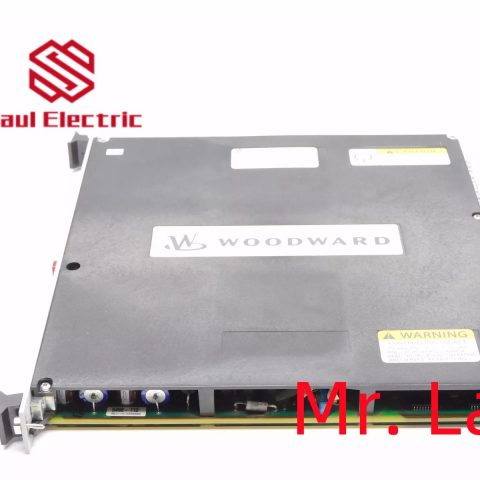
The Woodward 8915-005 belongs to the 505/505E series digital turbine controllers. It is a microprocessor-based control module designed for single-valve steam turbines,
including single extraction/admission systems or split-range actuator configurations.
The controller features a front panel Operator Control Panel (OCP) with a two-line, 24-character display and multi-function keypad, allowing easy on-site configuration and monitoring.
2. 8915-005 Technical Specifications and Parameters
| Parameter | Details |
|---|---|
| Power Supply | +24 VDC, approx. 1 A |
| I/O Outputs | Discrete Outputs: 8 Analog Outputs: 6 Actuator Outputs: 2 |
| Display / HMI | Two-line, 24-character LCD, with multi-function keypad |
| Dimensions | Approx. 14 × 11 × 4 in (35.6 × 27.9 × 10.2 cm) |
| Weight | Approx. 9.11 lbs (4.13 kg) |
| Operating Temperature | –4 to +140 °F (–20 to +60 °C) |
| Storage Temperature | –40 to +185 °F (–40 to +85 °C) |
| Humidity Standard | 95% RH at 20-55 °C for 48 hours without damage |
| Protection Class | Typically meets industrial dust and water protection standards |
| Communication Protocol | Supports Modbus, RS-232 / RS-422 serial interfaces |

3. Brand History
Woodward, Inc., founded in 1870 and headquartered in Fort Collins, Colorado, USA, is a global leader in energy control systems. The company has a long history of innovation in turbine control, engine management,
and power generation systems.
Woodward products are widely recognized for their reliability and precision in demanding industrial and power generation applications.
4. Applications in Industrial Automation
The 8915-005 plays a critical role in industrial automation and power generation environments:
- Steam Turbine Control: Manages startup, speed regulation, and extraction/admission control of steam turbines.
- Power Generation Systems: Used in power plants to regulate turbine-driven generators for stable frequency and load management.
- Compressor and Pump Drive Control: Ensures precise speed control for turbine-driven compressors and pumps.
- Process Industry Applications: Applied in chemical plants, refineries, and other industries requiring precise turbine operation.
- Safety and Protection Functions: Includes overspeed protection, critical speed avoidance, actuator travel limits, and event logging for operational safety.

The difference between half bridge driver and full bridge driver
Half bridge driver and full bridge driver are two common circuit drivers in the field of power electronics, which have significant differences in structure,
working principle, performance characteristics, and application scenarios. The following is a detailed analysis of the differences between the two:
1、 Structural differences
Half bridge driver:
The half bridge driver consists of two power semiconductor switches, namely the upper bridge arm and the lower bridge arm.
These two switches control the flow of current through control signals, thereby achieving control of the load.
The structure of a half bridge driver is relatively simple, usually consisting of only two main power switching elements, as well
as necessary control and protection circuits.
Full bridge driver:
The full bridge driver consists of four power switches and typically adopts a structure of two H-bridges (two on each side). Each
bridge arm has a switch that is symmetrically connected to the two-phase windings of the motor.
The structure of the full bridge driver is more complex, requiring more power switching components and control circuits to achieve precise control of the motor.


There are no reviews yet.