

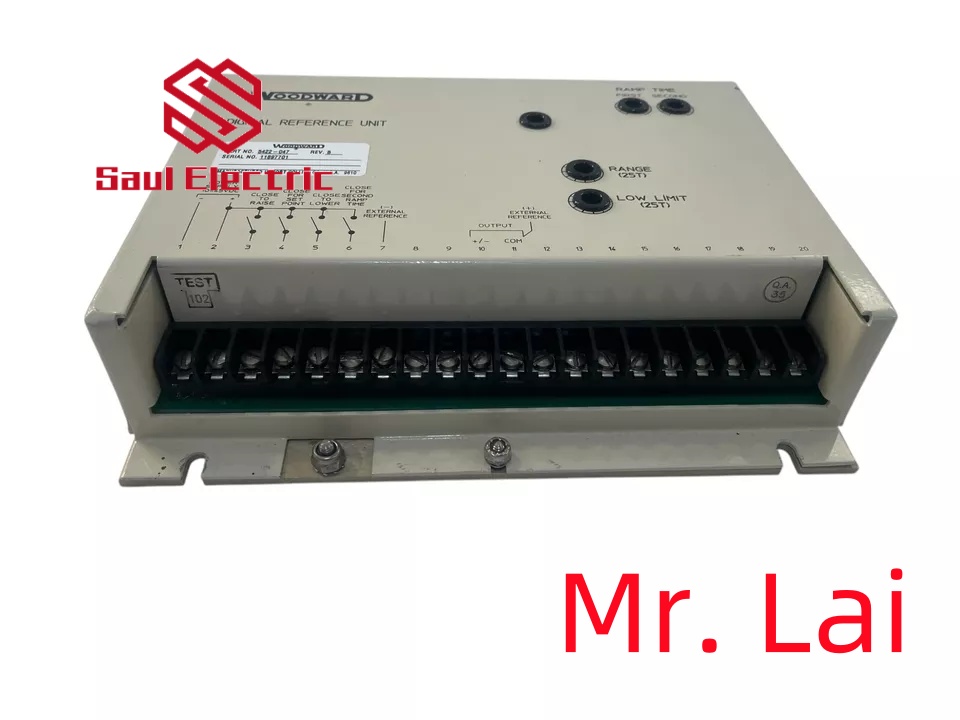
Woodward 8915-986 Price Discount | In Stock
1.8915-986 Product Overview

The Woodward 8915-986 belongs to the 505/505E series digital turbine controllers. It is a microprocessor-based control module designed for single-valve steam turbines,
including single extraction/admission systems or split-range actuator configurations.
The controller features a front panel Operator Control Panel (OCP) with a two-line, 24-character display and multi-function keypad, allowing easy on-site configuration and monitoring.
2. 8915-986 Technical Specifications and Parameters
| Parameter | Details |
|---|---|
| Power Supply | +24 VDC, approx. 1 A |
| I/O Outputs | Discrete Outputs: 8 Analog Outputs: 6 Actuator Outputs: 2 |
| Display / HMI | Two-line, 24-character LCD, with multi-function keypad |
| Dimensions | Approx. 14 × 11 × 4 in (35.6 × 27.9 × 10.2 cm) |
| Weight | Approx. 9.11 lbs (4.13 kg) |
| Operating Temperature | –4 to +140 °F (–20 to +60 °C) |
| Storage Temperature | –40 to +185 °F (–40 to +85 °C) |
| Humidity Standard | 95% RH at 20-55 °C for 48 hours without damage |
| Protection Class | Typically meets industrial dust and water protection standards |
| Communication Protocol | Supports Modbus, RS-232 / RS-422 serial interfaces |

3. Brand History
Woodward, Inc., founded in 1870 and headquartered in Fort Collins, Colorado, USA, is a global leader in energy control systems. The company has a long history of innovation in turbine control, engine management,
and power generation systems.
Woodward products are widely recognized for their reliability and precision in demanding industrial and power generation applications.
4. Applications in Industrial Automation
The 8915-986 plays a critical role in industrial automation and power generation environments:
- Steam Turbine Control: Manages startup, speed regulation, and extraction/admission control of steam turbines.
- Power Generation Systems: Used in power plants to regulate turbine-driven generators for stable frequency and load management.
- Compressor and Pump Drive Control: Ensures precise speed control for turbine-driven compressors and pumps.
- Process Industry Applications: Applied in chemical plants, refineries, and other industries requiring precise turbine operation.
- Safety and Protection Functions: Includes overspeed protection, critical speed avoidance, actuator travel limits, and event logging for operational safety.

Automotive Distributed EEA
In order to solve these problems of distributed EEA, people have gradually integrated many ECU functions that are similar or separated into
a processor hardware platform with stronger performance than ECU, which is the automotive “Domain Control Unit (DCU)”. The emergence
of domain controllers is an important milestone in the evolution of automotive EE architecture from ECU distributed EE architecture to domain
centralized EE architecture (as shown in Figure 2-2).
The domain controller is the core of every functional domain in the automotive industry, mainly composed of three parts: the domain main
control processor, the operating system, and application software and algorithms. Platformization, high integration, high performance, and good
compatibility are the main core design ideas of domain controllers. By relying on high-performance domain controller processors, abundant hardware
interface resources, and powerful software features, domain controllers can integrate
core functions that originally required many ECUs, greatly improving system functionality integration. In addition, standardized interfaces for data exchange
can greatly reduce the development and manufacturing costs of this part.
For the specific division of functional domains, each automotive host manufacturer will divide them into several different domains based on their own
design concepts. For example, BOSCH is divided into five domains: Power Train, Chassis, Body/Comfort, Cockpit/Entertainment, and ADAS.
This is also the most classic five domain centralized EEA, as shown in Figure 2-2. Some manufacturers further integrate the five domain centralized architecture
, merging the original power domain, chassis domain, and body domain
into the vehicle control domain, thus forming a three domain centralized EEA, namely: Vehicle Control Domain Controller (VDC), ADASAD Domain Controller (ADC)
, and Cockpit Domain Controller (CDC). Both Volkswagen”s MEB platform and Huawei”s CC architecture belong to this three domain centralized EEA.


There are no reviews yet.