

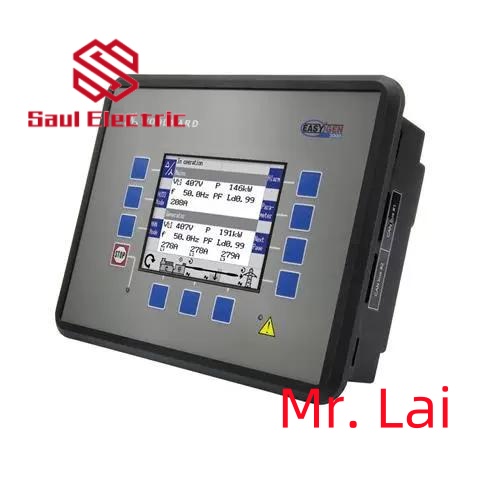
Woodward 990-05-50-02-00 505 Turbine Control | 100% Original
1.990-05-50-02-00 Product Overview

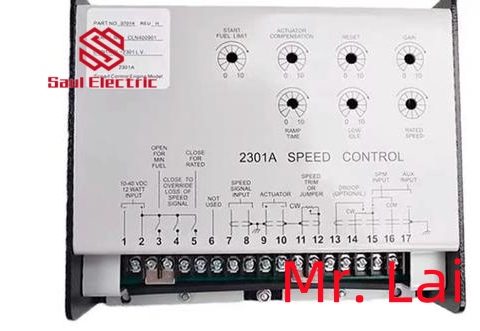
The Woodward 990-05-50-02-00 belongs to the 505/505E series digital turbine controllers. It is a microprocessor-based control module designed for single-valve steam turbines,
including single extraction/admission systems or split-range actuator configurations.
The controller features a front panel Operator Control Panel (OCP) with a two-line, 24-character display and multi-function keypad, allowing easy on-site configuration and monitoring.
2. 990-05-50-02-00 Technical Specifications and Parameters
| Parameter | Details |
|---|---|
| Power Supply | +24 VDC, approx. 1 A |
| I/O Outputs | Discrete Outputs: 8 Analog Outputs: 6 Actuator Outputs: 2 |
| Display / HMI | Two-line, 24-character LCD, with multi-function keypad |
| Dimensions | Approx. 14 × 11 × 4 in (35.6 × 27.9 × 10.2 cm) |
| Weight | Approx. 9.11 lbs (4.13 kg) |
| Operating Temperature | –4 to +140 °F (–20 to +60 °C) |
| Storage Temperature | –40 to +185 °F (–40 to +85 °C) |
| Humidity Standard | 95% RH at 20-55 °C for 48 hours without damage |
| Protection Class | Typically meets industrial dust and water protection standards |
| Communication Protocol | Supports Modbus, RS-232 / RS-422 serial interfaces |

3. Brand History
Woodward, Inc., founded in 1870 and headquartered in Fort Collins, Colorado, USA, is a global leader in energy control systems. The company has a long history of innovation in turbine control, engine management,
and power generation systems.
Woodward products are widely recognized for their reliability and precision in demanding industrial and power generation applications.
4. Applications in Industrial Automation
The 990-05-50-02-00 plays a critical role in industrial automation and power generation environments:
- Steam Turbine Control: Manages startup, speed regulation, and extraction/admission control of steam turbines.
- Power Generation Systems: Used in power plants to regulate turbine-driven generators for stable frequency and load management.
- Compressor and Pump Drive Control: Ensures precise speed control for turbine-driven compressors and pumps.
- Process Industry Applications: Applied in chemical plants, refineries, and other industries requiring precise turbine operation.
- Safety and Protection Functions: Includes overspeed protection, critical speed avoidance, actuator travel limits, and event logging for operational safety.

The implementation methods of sine wave controllers include analog control and digital control. Analog controllers generally use analog circuits such
as operational amplifiers to achieve motor control, which has the advantages of fast response and good real-time performance. However, the accuracy is
limited by the devices and the control accuracy is relatively low. Digital controllers control motors through
processors such as digital signal processors (DSPs), which have the advantages of high precision and strong programmability. However, they require
high-performance processors and complex control algorithms, resulting in high costs.
Sine wave controllers are widely used, especially in DC and AC frequency converters, to supply AC motors. By controlling the AC voltage and frequency,
sine wave controllers can achieve precise adjustment of motor speed and torque, and are widely used in industrial automation, robot control, electric vehicles, and other fields.
Vector controller and sine wave controller are commonly used control methods in motor controllers, and their main differences are as follows:
1. Different working principles: Vector controllers are based on vector control theory to achieve motor control, while sine wave controllers
control motors by directly controlling three-phase sine waves.
2. Different control accuracies: Vector controllers have higher control accuracy due to their ability to control motor torque and speed with high precision,
making them suitable for high-precision control fields. However, sine wave controllers have lower control accuracy than vector controllers and are suitable for some low precision controls.
3. Different adaptability to load: Vector controllers can detect and adjust load conditions in real time, which can better adapt to changes in load.
Sine wave controllers have lower adaptability to changes in load and require pre planning of control strategies.
4. The difficulty level of controller implementation varies: Vector controllers have complex processing techniques and generally require high-precision control algorithms and processors,
making them relatively difficult. The sine wave controller technology is relatively simple, and the controller implementation is relatively easy.
In short, vector controllers and sine wave controllers each have suitable application scenarios, and it is important to choose a motor control method that is suitable for your own application needs.


There are no reviews yet.