

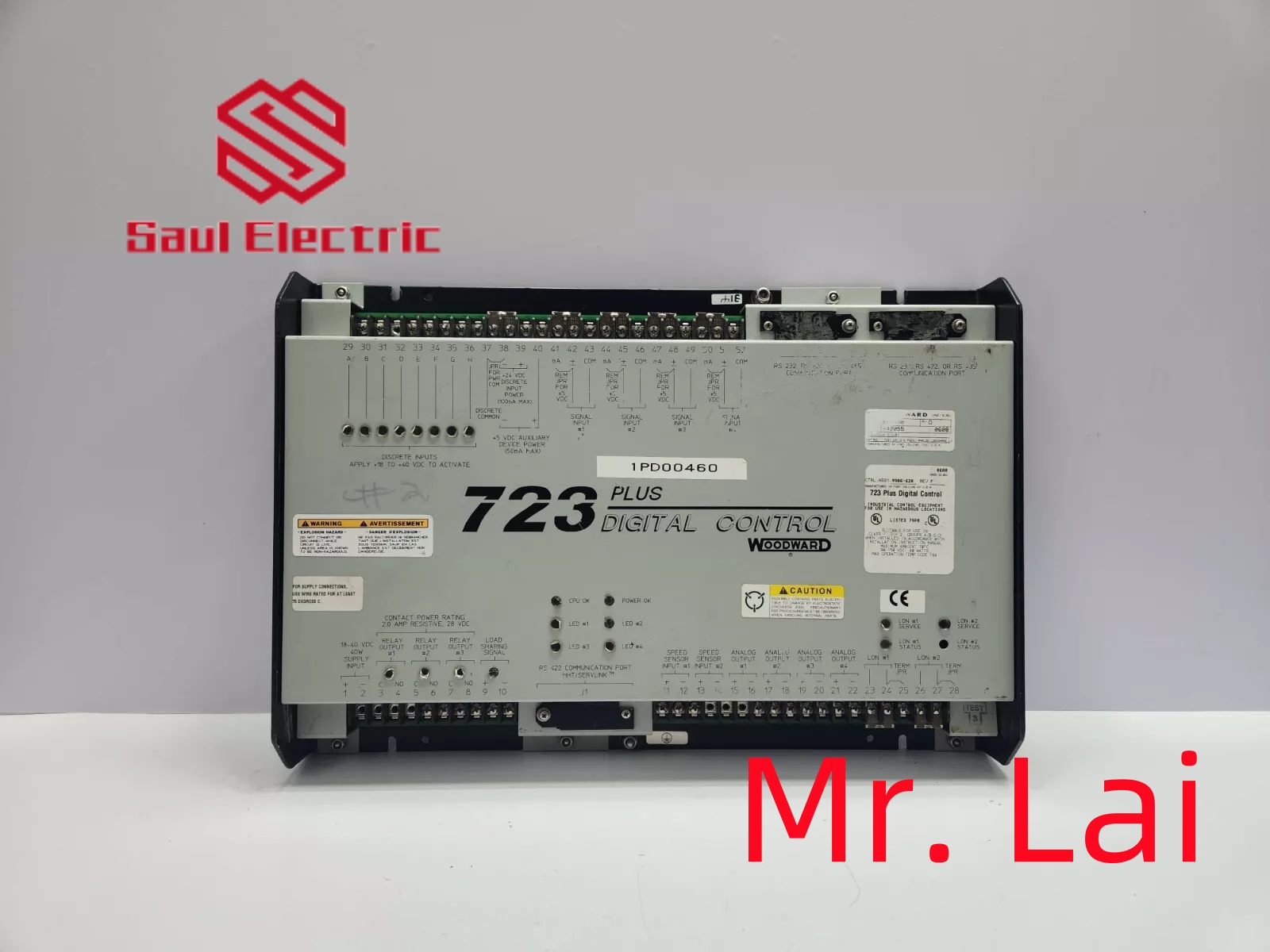
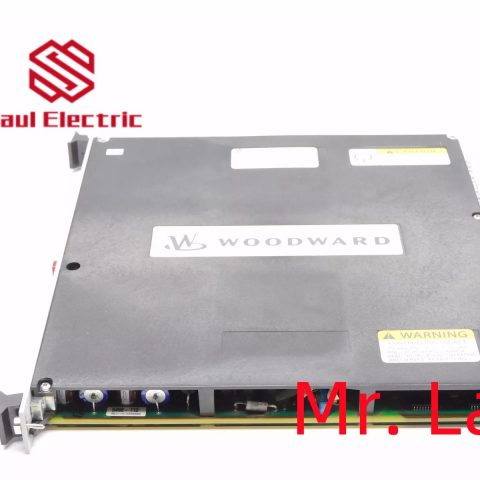
Woodward 9904-111 Price Discount | In Stock
1.9904-111 Product Overview

The Woodward 9904-111 belongs to the 505/505E series digital turbine controllers. It is a microprocessor-based control module designed for single-valve steam turbines,
including single extraction/admission systems or split-range actuator configurations.
The controller features a front panel Operator Control Panel (OCP) with a two-line, 24-character display and multi-function keypad, allowing easy on-site configuration and monitoring.
2. 9904-111 Technical Specifications and Parameters
| Parameter | Details |
|---|---|
| Power Supply | +24 VDC, approx. 1 A |
| I/O Outputs | Discrete Outputs: 8 Analog Outputs: 6 Actuator Outputs: 2 |
| Display / HMI | Two-line, 24-character LCD, with multi-function keypad |
| Dimensions | Approx. 14 × 11 × 4 in (35.6 × 27.9 × 10.2 cm) |
| Weight | Approx. 9.11 lbs (4.13 kg) |
| Operating Temperature | –4 to +140 °F (–20 to +60 °C) |
| Storage Temperature | –40 to +185 °F (–40 to +85 °C) |
| Humidity Standard | 95% RH at 20-55 °C for 48 hours without damage |
| Protection Class | Typically meets industrial dust and water protection standards |
| Communication Protocol | Supports Modbus, RS-232 / RS-422 serial interfaces |

3. Brand History
Woodward, Inc., founded in 1870 and headquartered in Fort Collins, Colorado, USA, is a global leader in energy control systems. The company has a long history of innovation in turbine control, engine management,
and power generation systems.
Woodward products are widely recognized for their reliability and precision in demanding industrial and power generation applications.
4. Applications in Industrial Automation
The 9904-111 plays a critical role in industrial automation and power generation environments:
- Steam Turbine Control: Manages startup, speed regulation, and extraction/admission control of steam turbines.
- Power Generation Systems: Used in power plants to regulate turbine-driven generators for stable frequency and load management.
- Compressor and Pump Drive Control: Ensures precise speed control for turbine-driven compressors and pumps.
- Process Industry Applications: Applied in chemical plants, refineries, and other industries requiring precise turbine operation.
- Safety and Protection Functions: Includes overspeed protection, critical speed avoidance, actuator travel limits, and event logging for operational safety.

Selection of stepper motor driver
Due to the wide variety of models and types of stepper motors and drivers, users should have certain considerations when choosing,
so as to choose the products they need with the best performance and lowest price.
1. Firstly, determine the torque required for the stepper motor to drive the load.
The simplest method is to add a lever on the load shaft, pull the lever with a spring scale, and multiply the tension by the length of the force arm to obtain the
load torque. Or theoretically calculated based on load characteristics.
Due to the fact that stepper motors are control motors, the maximum torque of commonly used stepper motors currently does not exceed 45Nm.
The higher the torque, the higher the cost. If the torque of the motor you choose is large or exceeds this range, you can consider adding a reduction device.
2. Determine the maximum operating speed of the stepper motor.
The speed index is crucial in the selection of stepper motors. The characteristic of stepper motors is that as the motor speed increases, the torque decreases,
and the speed of its decrease is related to many parameters, such as the driving voltage of the driver, the phase current of the motor, the phase inductance of the motor,
the size of the motor, etc. The general rule is that the higher the driving voltage, the slower the torque decrease; The larger the phase current of the motor, the slower the
torque decrease. When designing the scheme, www.diangon.com should control the motor speed within 600 rpm or 800 rpm. However, this statement is not standardized
and can be referred to in the “Torque Frequency Characteristics”.
3. Based on the two important indicators of maximum torque and maximum speed of the load, and referring to the “Torque Frequency Characteristics”, one can choose a
suitable stepper motor for oneself. If you think the motor you have chosen is too large, you can consider adding and reducing devices, which can save costs and make your design more flexible.
To choose a suitable reduction ratio, it is necessary to comprehensively consider the relationship between torque and speed and select the best solution.


There are no reviews yet.