

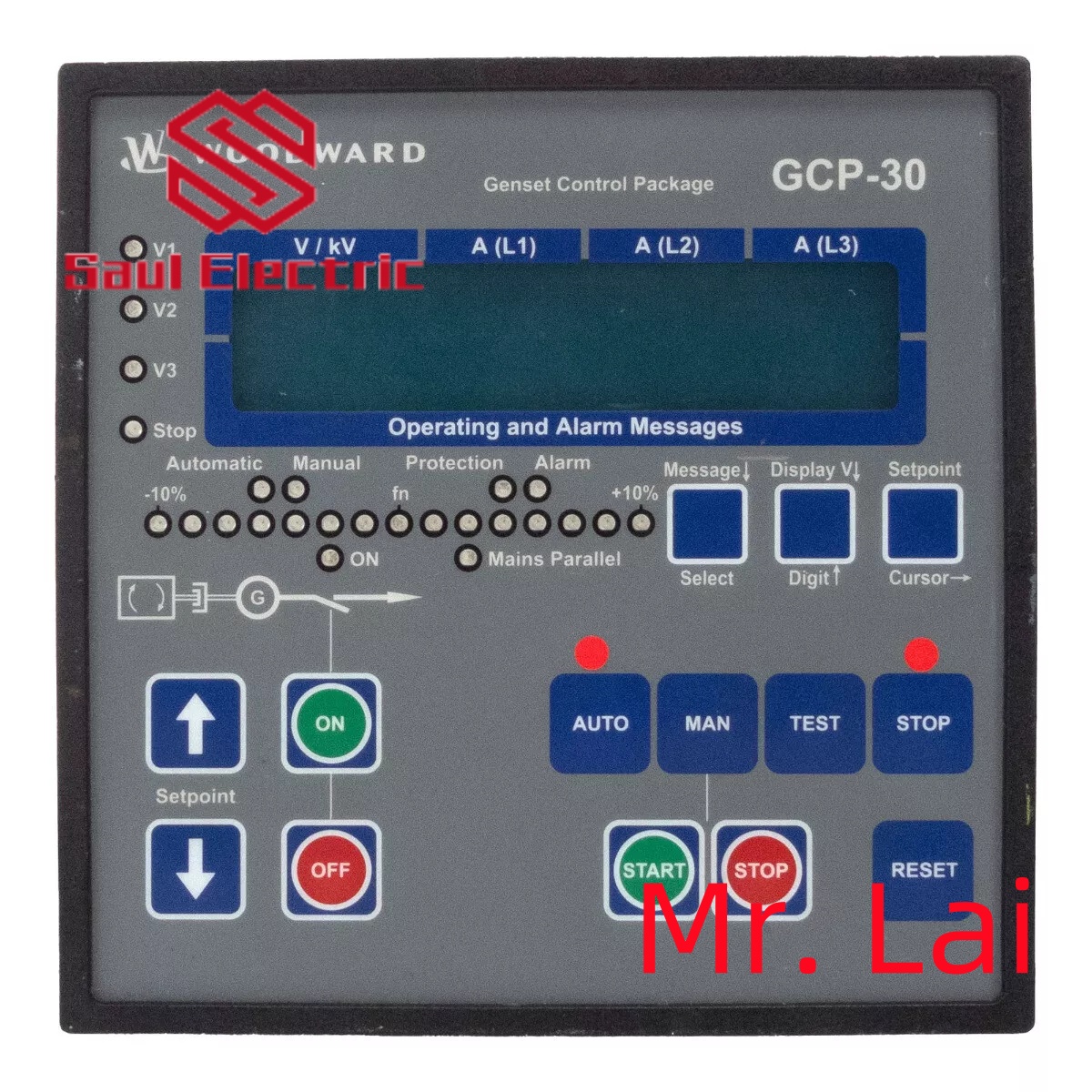
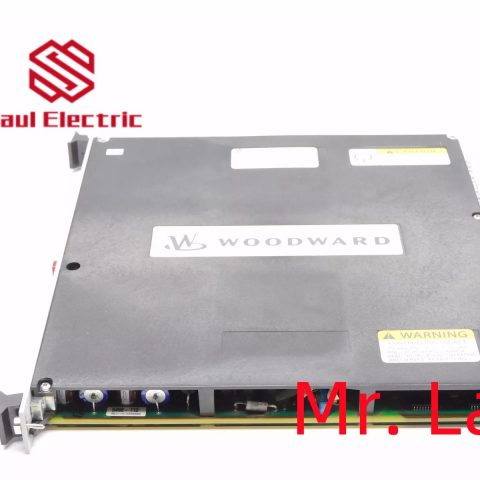
Woodward 9905-707 |CPU Module, Origin: United States
1.9905-707 Product Overview

The Woodward 9905-707 belongs to the 505/505E series digital turbine controllers. It is a microprocessor-based control module designed for single-valve steam turbines,
including single extraction/admission systems or split-range actuator configurations.
The controller features a front panel Operator Control Panel (OCP) with a two-line, 24-character display and multi-function keypad, allowing easy on-site configuration and monitoring.
2. 9905-707 Technical Specifications and Parameters
| Parameter | Details |
|---|---|
| Power Supply | +24 VDC, approx. 1 A |
| I/O Outputs | Discrete Outputs: 8 Analog Outputs: 6 Actuator Outputs: 2 |
| Display / HMI | Two-line, 24-character LCD, with multi-function keypad |
| Dimensions | Approx. 14 × 11 × 4 in (35.6 × 27.9 × 10.2 cm) |
| Weight | Approx. 9.11 lbs (4.13 kg) |
| Operating Temperature | –4 to +140 °F (–20 to +60 °C) |
| Storage Temperature | –40 to +185 °F (–40 to +85 °C) |
| Humidity Standard | 95% RH at 20-55 °C for 48 hours without damage |
| Protection Class | Typically meets industrial dust and water protection standards |
| Communication Protocol | Supports Modbus, RS-232 / RS-422 serial interfaces |

3. Brand History
Woodward, Inc., founded in 1870 and headquartered in Fort Collins, Colorado, USA, is a global leader in energy control systems. The company has a long history of innovation in turbine control, engine management,
and power generation systems.
Woodward products are widely recognized for their reliability and precision in demanding industrial and power generation applications.
4. Applications in Industrial Automation
The 9905-707 plays a critical role in industrial automation and power generation environments:
- Steam Turbine Control: Manages startup, speed regulation, and extraction/admission control of steam turbines.
- Power Generation Systems: Used in power plants to regulate turbine-driven generators for stable frequency and load management.
- Compressor and Pump Drive Control: Ensures precise speed control for turbine-driven compressors and pumps.
- Process Industry Applications: Applied in chemical plants, refineries, and other industries requiring precise turbine operation.
- Safety and Protection Functions: Includes overspeed protection, critical speed avoidance, actuator travel limits, and event logging for operational safety.

In the above figure, as the gain of the I controller decreases, the steady-state error also gradually decreases. For most cases,
PI controllers are particularly suitable for situations that do not require high-speed response.
When using a PI controller, the output of the I-controller is limited within a certain range, overcoming integral saturation,
where the transition of the integral output, even as the zero error state increases, is due to the nonlinear conditions of the plant.
The input-output of PID controller and the control implementation of PID controller
D-controller
The I-controller does not have the ability to predict erroneous future behavior. So once the set value changes, it will react normally.
The D controller overcomes this problem by predicting future erroneous behavior. Its output depends on the rate of change of error
relative to time, multiplied by a differential constant. It provides startup for output, thereby increasing system response.
The input-output of PID controller and the control implementation of PID controller
In the above figure, the response of the D controller is higher than that of the PI controller, and the establishment time of the output is
also reduced. It improves the stability of the system by compensating for the phase lag caused by the I controller. Increasing the differential gain will improve the response speed.


There are no reviews yet.