

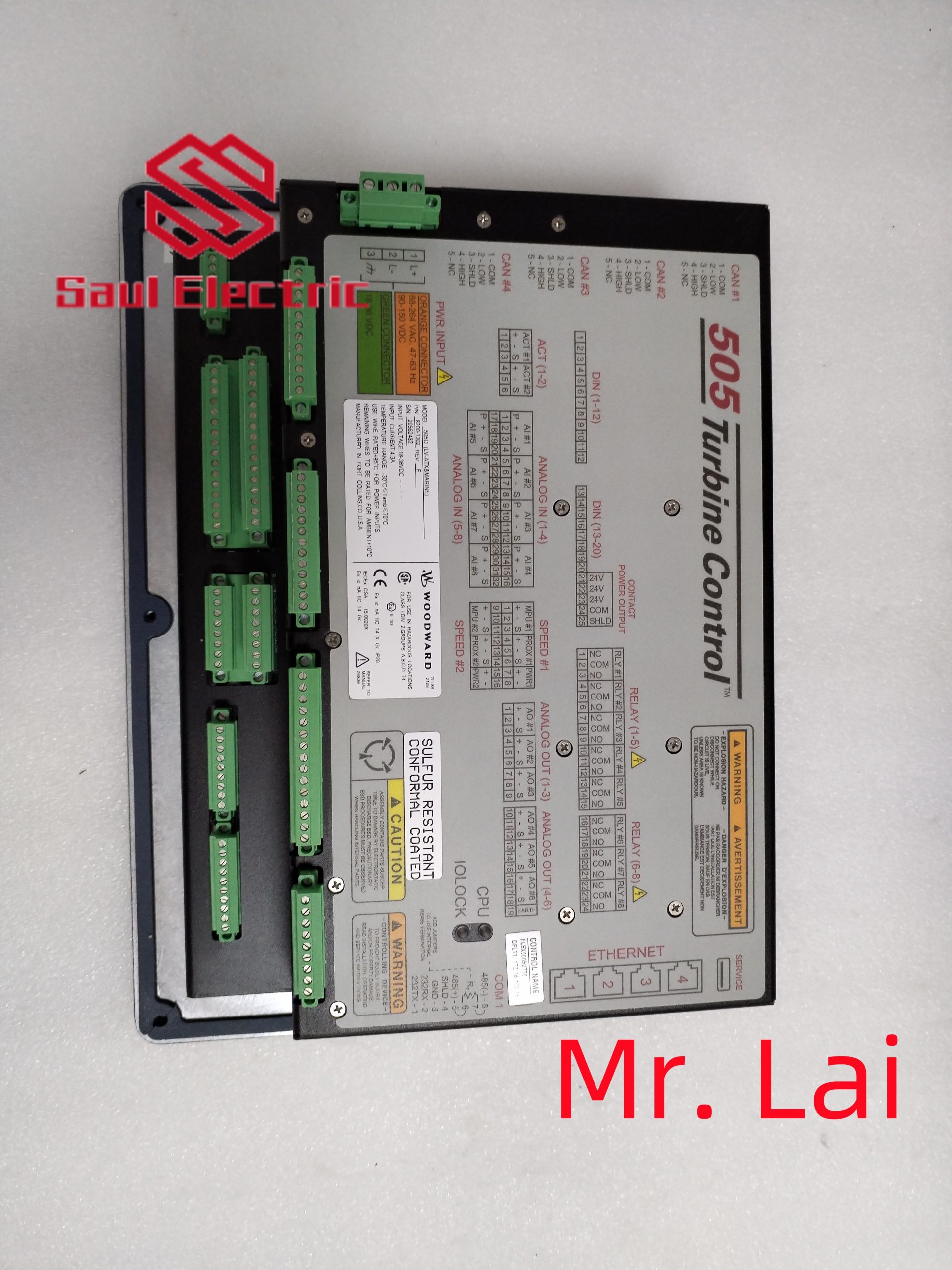
Woodward 9905-763 |CPU Module, Origin: United States
1.9905-763 Product Overview

The Woodward 9905-763 belongs to the 505/505E series digital turbine controllers. It is a microprocessor-based control module designed for single-valve steam turbines,
including single extraction/admission systems or split-range actuator configurations.
The controller features a front panel Operator Control Panel (OCP) with a two-line, 24-character display and multi-function keypad, allowing easy on-site configuration and monitoring.
2. 9905-763 Technical Specifications and Parameters
| Parameter | Details |
|---|---|
| Power Supply | +24 VDC, approx. 1 A |
| I/O Outputs | Discrete Outputs: 8 Analog Outputs: 6 Actuator Outputs: 2 |
| Display / HMI | Two-line, 24-character LCD, with multi-function keypad |
| Dimensions | Approx. 14 × 11 × 4 in (35.6 × 27.9 × 10.2 cm) |
| Weight | Approx. 9.11 lbs (4.13 kg) |
| Operating Temperature | –4 to +140 °F (–20 to +60 °C) |
| Storage Temperature | –40 to +185 °F (–40 to +85 °C) |
| Humidity Standard | 95% RH at 20-55 °C for 48 hours without damage |
| Protection Class | Typically meets industrial dust and water protection standards |
| Communication Protocol | Supports Modbus, RS-232 / RS-422 serial interfaces |

3. Brand History
Woodward, Inc., founded in 1870 and headquartered in Fort Collins, Colorado, USA, is a global leader in energy control systems. The company has a long history of innovation in turbine control, engine management,
and power generation systems.
Woodward products are widely recognized for their reliability and precision in demanding industrial and power generation applications.
4. Applications in Industrial Automation
The 9905-763 plays a critical role in industrial automation and power generation environments:
- Steam Turbine Control: Manages startup, speed regulation, and extraction/admission control of steam turbines.
- Power Generation Systems: Used in power plants to regulate turbine-driven generators for stable frequency and load management.
- Compressor and Pump Drive Control: Ensures precise speed control for turbine-driven compressors and pumps.
- Process Industry Applications: Applied in chemical plants, refineries, and other industries requiring precise turbine operation.
- Safety and Protection Functions: Includes overspeed protection, critical speed avoidance, actuator travel limits, and event logging for operational safety.

What is a switch chip driver
Switch chip drivers typically refer to software components used in network switches or similar network devices to control and manage the operation of switch chips.
This driver is the interface between the hardware device and the operating system, which enables the operating system to recognize and
use the switching chip to perform network tasks such as packet transmission, filtering, and forwarding. The following is a detailed explanation of the switch chip driver:
Function and Function:
Hardware identification and initialization: When the switch chip is installed in the system, the driver is responsible for notifying the
operating system of the existence of new hardware and completing the hardware initialization work, including loading necessary firmware
and configuring the parameters of the switch chip.
Data transmission control: The driver manages the transmission of data packets between the switch chip and the network,
as well as between different ports within the switch chip. It determines the routing of data packets based on network protocols
and the destination address of the packets.
Network protocol support: The switch chip driver implements the relevant parts of the network protocol stack, supporting
standard protocols such as TCP/IP, Ethernet, etc., to ensure that data packets can be properly encapsulated and decapsulated.
Error handling and diagnosis: The driver is responsible for monitoring the status of the switch chip, detecting and handling
possible errors such as packet conflicts, link failures, etc. Meanwhile, it also provides network diagnostic tools to assist
administrators in analyzing and resolving network issues.
Performance optimization: Switching chip drivers improve data transmission efficiency, reduce latency, and enhance overall
network performance by optimizing algorithms and buffer management.
User Interface: The driver provides a user interface that allows network administrators to configure switch chip settings,
such as VLAN partitioning, QoS policies, port mirroring, etc.



There are no reviews yet.