

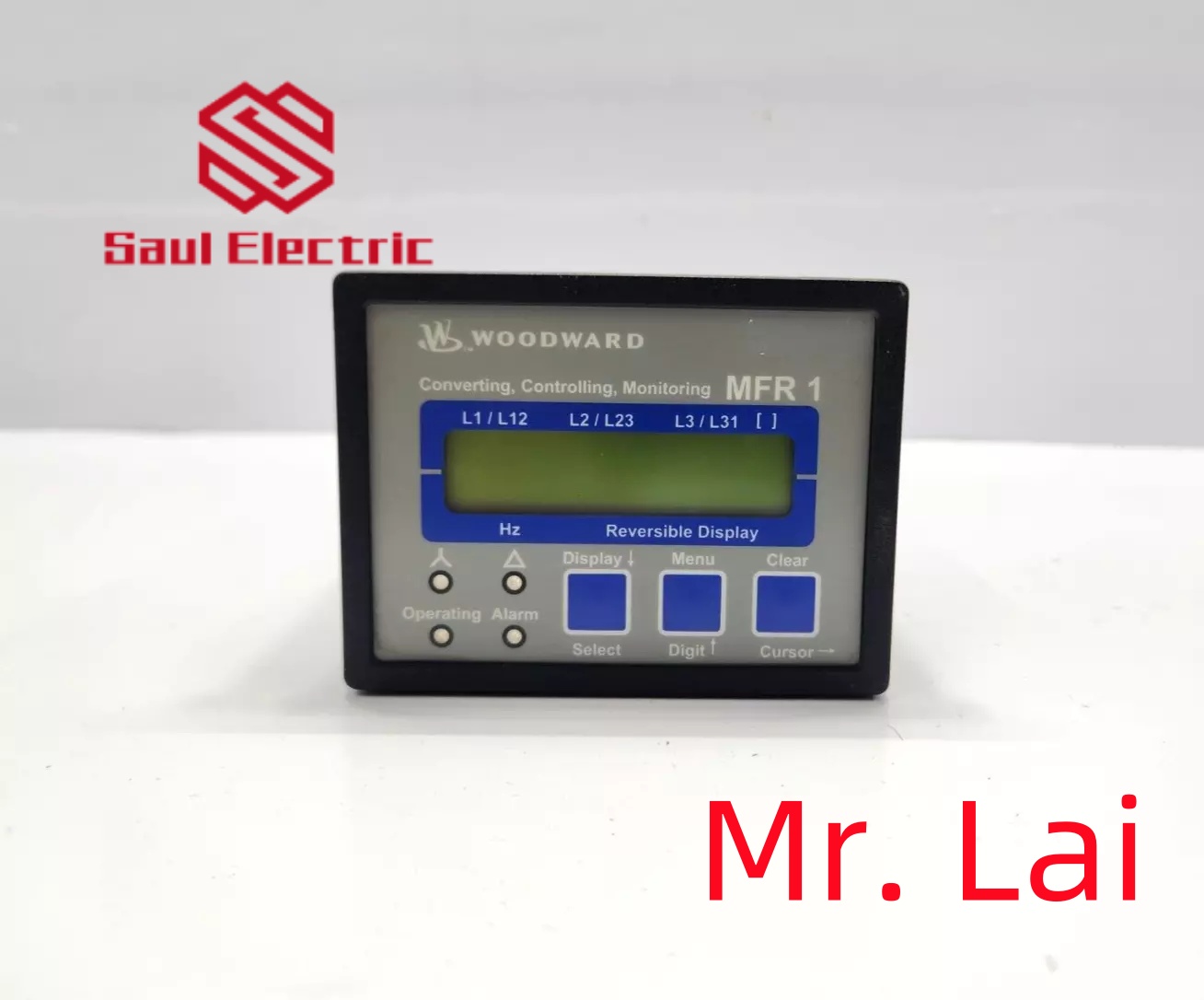
Woodward 9905-764 505 Turbine Control | 100% Original
1.9905-764 Product Overview

The Woodward 9905-764 belongs to the 505/505E series digital turbine controllers. It is a microprocessor-based control module designed for single-valve steam turbines,
including single extraction/admission systems or split-range actuator configurations.
The controller features a front panel Operator Control Panel (OCP) with a two-line, 24-character display and multi-function keypad, allowing easy on-site configuration and monitoring.
2. 9905-764 Technical Specifications and Parameters
| Parameter | Details |
|---|---|
| Power Supply | +24 VDC, approx. 1 A |
| I/O Outputs | Discrete Outputs: 8 Analog Outputs: 6 Actuator Outputs: 2 |
| Display / HMI | Two-line, 24-character LCD, with multi-function keypad |
| Dimensions | Approx. 14 × 11 × 4 in (35.6 × 27.9 × 10.2 cm) |
| Weight | Approx. 9.11 lbs (4.13 kg) |
| Operating Temperature | –4 to +140 °F (–20 to +60 °C) |
| Storage Temperature | –40 to +185 °F (–40 to +85 °C) |
| Humidity Standard | 95% RH at 20-55 °C for 48 hours without damage |
| Protection Class | Typically meets industrial dust and water protection standards |
| Communication Protocol | Supports Modbus, RS-232 / RS-422 serial interfaces |

3. Brand History
Woodward, Inc., founded in 1870 and headquartered in Fort Collins, Colorado, USA, is a global leader in energy control systems. The company has a long history of innovation in turbine control, engine management,
and power generation systems.
Woodward products are widely recognized for their reliability and precision in demanding industrial and power generation applications.
4. Applications in Industrial Automation
The 9905-764 plays a critical role in industrial automation and power generation environments:
- Steam Turbine Control: Manages startup, speed regulation, and extraction/admission control of steam turbines.
- Power Generation Systems: Used in power plants to regulate turbine-driven generators for stable frequency and load management.
- Compressor and Pump Drive Control: Ensures precise speed control for turbine-driven compressors and pumps.
- Process Industry Applications: Applied in chemical plants, refineries, and other industries requiring precise turbine operation.
- Safety and Protection Functions: Includes overspeed protection, critical speed avoidance, actuator travel limits, and event logging for operational safety.

Important project testing
4.2.1 External current limit reduction test
When a voltage of -10V is applied to the XX terminal of the tested driver, the overcurrent monitoring function of the speed controller becomes ineffective.
According to the current reduction characteristic curve, it can be seen that the maximum output current is limited to 40% Imax. Set the speed setpoint to -5V,
turn on the drive enable for 3 minutes and then turn it off. Measure the waveform of the detection hole, and the Iist amplitude should be 4+0.4V.
The “overcurrent” indicator light is not on. The current reduction characteristic curve is shown in Figure 6.
Figure 6: Current reduction characteristic curve
4.2.2I2t monitoring test
The I2t function approximates the square of the actual current value and integrates the result. If the actual current value is 1.1 times the rated value,
the integrator integrates negatively, otherwise it integrates positively.
The specific test uses a test power board instead of the power module of the driver, closes the corresponding switch, and applies -1V
voltage to the XX terminal. According to the XX characteristic curve, the maximum output current is 100% Imax. In this testing interface, the speed is
set to -5V, the drive is enabled to open, and the waveform of W-hole Iist is measured. The recorded data is input into the corresponding unit, and the
backend software can provide a conclusion on whether it is qualified or not through calculation (the final trend of Iist amplitude decrease should be 1.1IN,
and the maximum amplitude holding time T should be).
5. Conclusion
The drive testing system can test the drive in both offline and online states. The testing system can help debugging personnel quickly determine
and understand the status of the drive during debugging or use, and propose solutions. The operation is simple and fast, with good human-computer interaction.
The system follows the principles of generalization, standardization, and modular design, and has good interactivity, portability,
and scalability. The design of this testing system has been completed, providing great convenience for the maintenance and repair of the drive. At the same time,
a portable drive testing system is also under research and design and will be completed soon.


There are no reviews yet.