

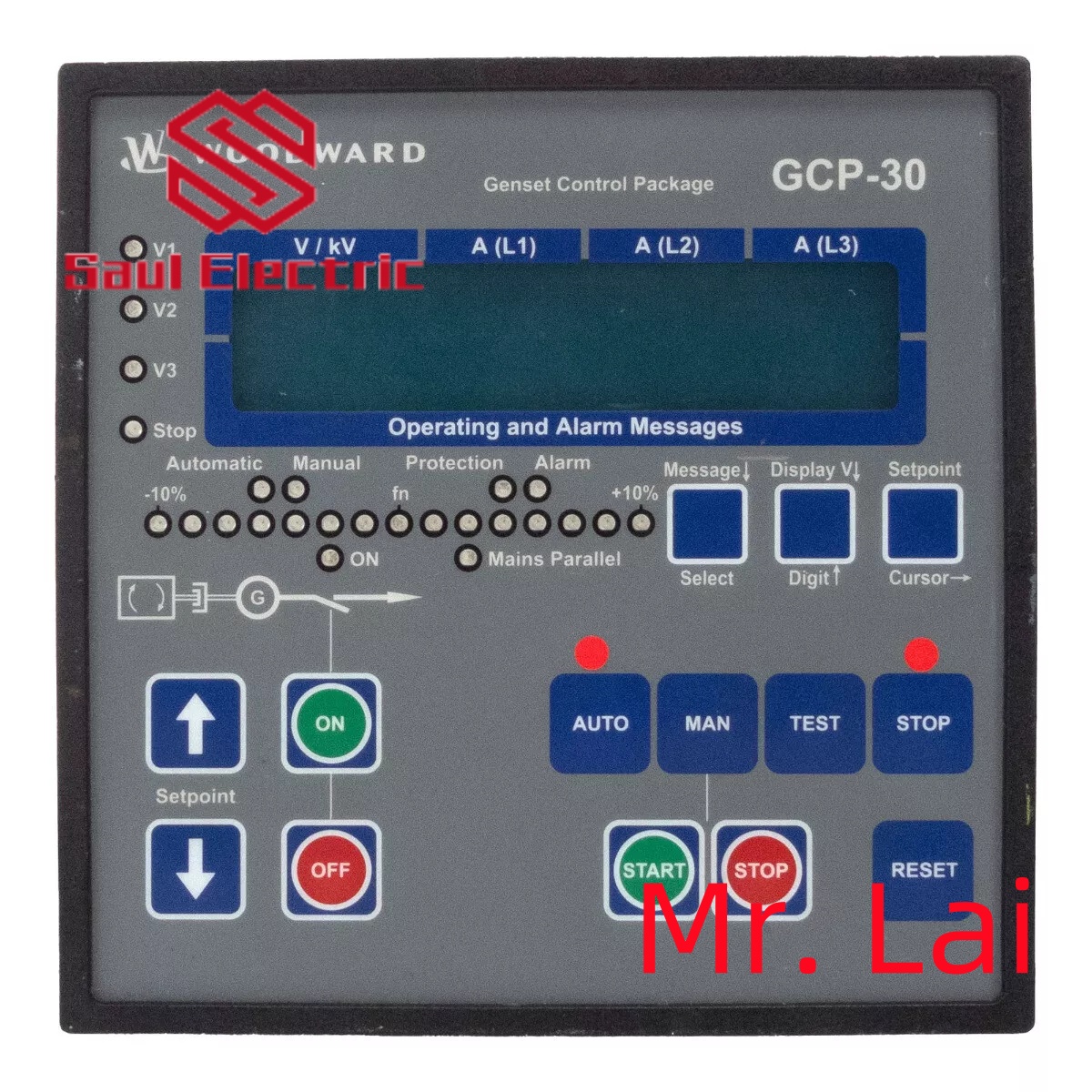
Woodward 9906-124 505 Turbine Control | 100% Original
1.9906-124 Product Overview

The Woodward 9906-124 belongs to the 505/505E series digital turbine controllers. It is a microprocessor-based control module designed for single-valve steam turbines,
including single extraction/admission systems or split-range actuator configurations.
The controller features a front panel Operator Control Panel (OCP) with a two-line, 24-character display and multi-function keypad, allowing easy on-site configuration and monitoring.
2. 9906-124 Technical Specifications and Parameters
| Parameter | Details |
|---|---|
| Power Supply | +24 VDC, approx. 1 A |
| I/O Outputs | Discrete Outputs: 8 Analog Outputs: 6 Actuator Outputs: 2 |
| Display / HMI | Two-line, 24-character LCD, with multi-function keypad |
| Dimensions | Approx. 14 × 11 × 4 in (35.6 × 27.9 × 10.2 cm) |
| Weight | Approx. 9.11 lbs (4.13 kg) |
| Operating Temperature | –4 to +140 °F (–20 to +60 °C) |
| Storage Temperature | –40 to +185 °F (–40 to +85 °C) |
| Humidity Standard | 95% RH at 20-55 °C for 48 hours without damage |
| Protection Class | Typically meets industrial dust and water protection standards |
| Communication Protocol | Supports Modbus, RS-232 / RS-422 serial interfaces |

3. Brand History
Woodward, Inc., founded in 1870 and headquartered in Fort Collins, Colorado, USA, is a global leader in energy control systems. The company has a long history of innovation in turbine control, engine management,
and power generation systems.
Woodward products are widely recognized for their reliability and precision in demanding industrial and power generation applications.
4. Applications in Industrial Automation
The 9906-124 plays a critical role in industrial automation and power generation environments:
- Steam Turbine Control: Manages startup, speed regulation, and extraction/admission control of steam turbines.
- Power Generation Systems: Used in power plants to regulate turbine-driven generators for stable frequency and load management.
- Compressor and Pump Drive Control: Ensures precise speed control for turbine-driven compressors and pumps.
- Process Industry Applications: Applied in chemical plants, refineries, and other industries requiring precise turbine operation.
- Safety and Protection Functions: Includes overspeed protection, critical speed avoidance, actuator travel limits, and event logging for operational safety.

Input and output of PID controller
Input
The measured (controlled) value of the controlled object – PV, also known as process value; Usually comes from measuring units.
The set value of the controlled object – SP or SV, also known as the set value; Usually comes from the operating unit.
output:
The output value of the PID controller – CO, CV, or MV, also known as the PID output value; Generally output to handheld devices or output cards.
Parameter tuning of PID controller
The parameter tuning of PID controller is the core content of control system design. It determines the proportional coefficient, integration time,
and differentiation time of the PID controller based on the characteristics of the controlled process. There are many methods for tuning PID controller parameters,
which can be summarized into two categories: one is theoretical calculation tuning method. It mainly determines the controller parameters through theoretical calculations
based on the mathematical model of the system. The calculation data obtained by this method may not be directly usable and must be adjusted and modified through
engineering practice. The second is the engineering tuning method, which mainly relies on engineering experience and is directly carried out in the testing of control
systems. The method is simple and easy to master, and is widely used in engineering practice. The engineering tuning methods for PID controller parameters
mainly include critical ratio method, reaction curve method, and attenuation method. Each of the three methods has its own characteristics, and their commonality is
to conduct experiments and then adjust the controller parameters according to engineering experience formulas. However, no matter which method is used,
the controller parameters need to be finally adjusted and improved in actual operation. The commonly used method now is the critical ratio method.
The steps for tuning PID controller parameters using this method are as follows: (1) Firstly, select a sufficiently short sampling period for the system to operate;
(2) Only add a proportional control loop until the system exhibits critical oscillation in response to the step response of the input. Record the proportional amplification
factor and critical oscillation period at this point; (3) Calculate the parameters of the PID controller through formulas under a certain degree of control.




There are no reviews yet.