

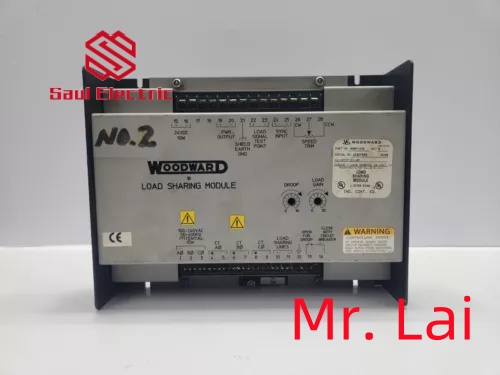
Woodward 9907-624 from SAUL ELECTRIC | In Stock
1.9907-624 Product Overview

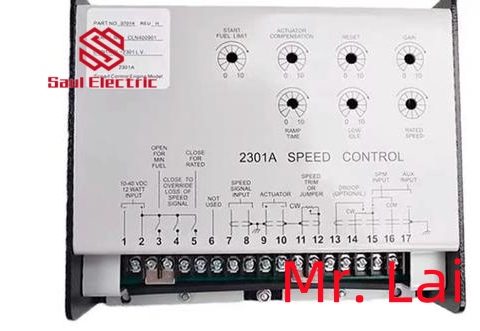
The Woodward 9907-624 belongs to the 505/505E series digital turbine controllers. It is a microprocessor-based control module designed for single-valve steam turbines,
including single extraction/admission systems or split-range actuator configurations.
The controller features a front panel Operator Control Panel (OCP) with a two-line, 24-character display and multi-function keypad, allowing easy on-site configuration and monitoring.
2. 9907-624 Technical Specifications and Parameters
| Parameter | Details |
|---|---|
| Power Supply | +24 VDC, approx. 1 A |
| I/O Outputs | Discrete Outputs: 8 Analog Outputs: 6 Actuator Outputs: 2 |
| Display / HMI | Two-line, 24-character LCD, with multi-function keypad |
| Dimensions | Approx. 14 × 11 × 4 in (35.6 × 27.9 × 10.2 cm) |
| Weight | Approx. 9.11 lbs (4.13 kg) |
| Operating Temperature | –4 to +140 °F (–20 to +60 °C) |
| Storage Temperature | –40 to +185 °F (–40 to +85 °C) |
| Humidity Standard | 95% RH at 20-55 °C for 48 hours without damage |
| Protection Class | Typically meets industrial dust and water protection standards |
| Communication Protocol | Supports Modbus, RS-232 / RS-422 serial interfaces |

3. Brand History
Woodward, Inc., founded in 1870 and headquartered in Fort Collins, Colorado, USA, is a global leader in energy control systems. The company has a long history of innovation in turbine control, engine management,
and power generation systems.
Woodward products are widely recognized for their reliability and precision in demanding industrial and power generation applications.
4. Applications in Industrial Automation
The 9907-624 plays a critical role in industrial automation and power generation environments:
- Steam Turbine Control: Manages startup, speed regulation, and extraction/admission control of steam turbines.
- Power Generation Systems: Used in power plants to regulate turbine-driven generators for stable frequency and load management.
- Compressor and Pump Drive Control: Ensures precise speed control for turbine-driven compressors and pumps.
- Process Industry Applications: Applied in chemical plants, refineries, and other industries requiring precise turbine operation.
- Safety and Protection Functions: Includes overspeed protection, critical speed avoidance, actuator travel limits, and event logging for operational safety.

In many products, such as microwave ovens, the requirements for microcontroller performance are very low, and price is the main consideration factor.
In this situation, manufacturers began designing dedicated microcontroller chips – an embedded central processing unit designed specifically for low cost,
small size, and low power consumption. Motorola 6811 and Intel 8051 are both successful examples of this type of chip. In addition, there is
a series of controllers called “PIC microcontrollers” produced by Microchip, which are also very popular. By today”s standards, these central processing
units are unbelievably simple; But the price for bulk purchases is very low, and often only one piece is needed to meet the needs of product designers.
A typical low-end microcontroller chip has approximately 1000 bytes of read-only memory and 20 bytes of random access memory, with 8 input/output pins.
Mass production of this chip costs only a few cents per unit. Of course,
you can”t expect to run programs like Microsoft Word on this chip – because Microsoft Word requires about 30 megabytes of random access storage
space and a processor that can execute millions of instructions per second. However, controlling a microwave oven does not require a complex program
like Microsoft Word. What you need to accomplish with a microcontroller is a specific task, and low-cost, low-power operation is the most important.
Application of Microcontrollers
In the article on the working principle of electronic gates, you learned about the 7400 series TTL (transistor logic circuit) components, where to purchase them,
and how to assemble them. You will find that implementing a simple device usually requires many gate circuits. For example, in the digital clock section,
the clock we designed may require 15 to 20 chips. One of the main advantages of microcontrollers is that software (the small program you write and execute
on the controller) can replace many gate circuits. Therefore, in this article, we will use a microcontroller to create a digital clock. This will be a very expensive
digital clock (nearly $200!), but in the process, you will accumulate various knowledge needed to use microcontrollers in the coming years. Even if you don”t actually make such a digital clock, reading related content can benefit you a lot.


There are no reviews yet.