

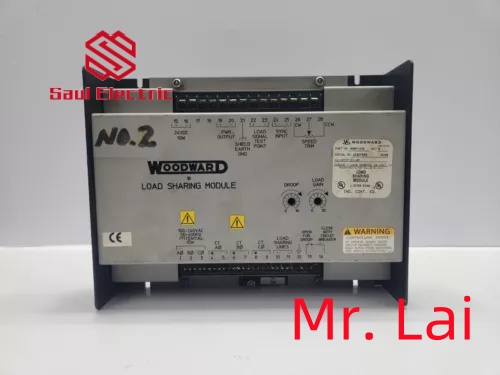
Woodward SPM-D10 | Governor | Controller | Potential Converter
1.SPM-D10 Product Overview

The Woodward SPM-D10 belongs to the 505/505E series digital turbine controllers. It is a microprocessor-based control module designed for single-valve steam turbines,
including single extraction/admission systems or split-range actuator configurations.
The controller features a front panel Operator Control Panel (OCP) with a two-line, 24-character display and multi-function keypad, allowing easy on-site configuration and monitoring.
2. SPM-D10 Technical Specifications and Parameters
| Parameter | Details |
|---|---|
| Power Supply | +24 VDC, approx. 1 A |
| I/O Outputs | Discrete Outputs: 8 Analog Outputs: 6 Actuator Outputs: 2 |
| Display / HMI | Two-line, 24-character LCD, with multi-function keypad |
| Dimensions | Approx. 14 × 11 × 4 in (35.6 × 27.9 × 10.2 cm) |
| Weight | Approx. 9.11 lbs (4.13 kg) |
| Operating Temperature | –4 to +140 °F (–20 to +60 °C) |
| Storage Temperature | –40 to +185 °F (–40 to +85 °C) |
| Humidity Standard | 95% RH at 20-55 °C for 48 hours without damage |
| Protection Class | Typically meets industrial dust and water protection standards |
| Communication Protocol | Supports Modbus, RS-232 / RS-422 serial interfaces |

3. Brand History
Woodward, Inc., founded in 1870 and headquartered in Fort Collins, Colorado, USA, is a global leader in energy control systems. The company has a long history of innovation in turbine control, engine management,
and power generation systems.
Woodward products are widely recognized for their reliability and precision in demanding industrial and power generation applications.
4. Applications in Industrial Automation
The SPM-D10 plays a critical role in industrial automation and power generation environments:
- Steam Turbine Control: Manages startup, speed regulation, and extraction/admission control of steam turbines.
- Power Generation Systems: Used in power plants to regulate turbine-driven generators for stable frequency and load management.
- Compressor and Pump Drive Control: Ensures precise speed control for turbine-driven compressors and pumps.
- Process Industry Applications: Applied in chemical plants, refineries, and other industries requiring precise turbine operation.
- Safety and Protection Functions: Includes overspeed protection, critical speed avoidance, actuator travel limits, and event logging for operational safety.

Control Implementation of PID Controller
1. Feedback logic of PID
The feedback logic terms of various frequency converters are different, and there are even cases where similar terms have opposite meanings.
The system design should be based on the instruction manual of the selected frequency converter. The so-called feedback logic refers to the control polarity
of the output frequency of the frequency converter based on the feedback signal detected by
the sensor of the controlled physical quantity. For example, in the central air conditioning system, the return water temperature is used to control and regulate the
output frequency of the frequency converter and the speed of the water pump motor. When heating in winter, if the return water temperature is low and the feedback
signal decreases, it indicates that the room temperature is low. It is required to increase the output frequency of the frequency converter and the motor speed, and increase
the flow rate of hot water; During summer cooling, if the return water temperature is too low and the feedback signal decreases, it indicates that the room temperature is too low.
This can reduce the output frequency of the frequency converter and motor speed, and decrease the flow of cold water. As can be seen from the above, when the temperature is also low,
the feedback signal decreases, but the frequency change direction of the frequency converter is required to be opposite. This is the reason for introducing feedback logic.
The functional selection of several frequency converter feedback logics is shown in Table 1.
2. Enable PID function
To achieve closed-loop PID control function, the PID function should first be pre-set as valid. There are two specific methods: one is to preset the function parameter
code of the frequency converter. For example, in the Convo CVF-G2 series frequency converter, when the parameter H-48 is set to O, there is no PID function; When set to 1,
it is a normal PID control; When set to 2, it is the constant pressure water supply PID. The second is determined by the
status of the external multifunctional terminals of the frequency converter. For example, in the Yaskawa CIMR-G 7A series frequency converter, as shown in Figure 1,
select any one of the multifunctional input terminals Sl-S10 and preset the function codes H1-01 to H1-10 (corresponding to terminals S1-S10) to 19. This terminal has the
function of determining whether PI [) control is effective. It is invalid when it is “ON” and effective when it is “OFF” with the common terminal SC.
It should be noted that most frequency converters have both of the above preset methods, but there are a few brands of frequency converters that only have one of them.
In some systems with less strict control requirements, sometimes only using PI control function without activating D function can meet the needs, and the system debugging process is relatively simple.


There are no reviews yet.